

If you've ever wondered why some organizations use clumsy, disconnected tools while others appear to work smoothly, the answer is often software. It mostly concerns enterprise software development. Enterprise software development entails more than just coding. It's about solving real-world business problems at scale, involving thousands of users, multiple departments, and hundreds of integrations.
This enterprise software development guide is written for the people who have to make that decision: CTOs evaluating major system overhauls, business owners asking whether custom development is worth the investment, and product managers trying to align technical roadmaps with real business goals. You will find honest answers here: what this kind of work actually costs, how long it realistically takes, what development model fits your situation, and how to build or find a team you can trust.
What Is Enterprise Software Development?
Enterprise software development is fundamentally the discipline of designing, creating, and implementing large-scale digital systems built for the operational complexity of organizations, not individuals. While consumer software may serve millions of users by performing simple tasks, an enterprise system organizes work across departments, countries, and data environments spanning decades of architecture.
What distinguishes enterprise software is not just scale, but stakes. These systems handle financial transactions, maintain customer connections, coordinate supply chains, and ensure regulatory compliance. They aren't nice to have. They are the infrastructure that businesses cannot function without. When they perform well, they become invisible, the solid foundation upon which everything else is built. When they fail, the ramifications affect the entire organization.
Enterprise software also tends to be deeply customized. A mid-sized law firm managing thousands of client matters, a logistics company optimizing 15,000 daily shipments, or a healthcare network coordinating patient records across 60 locations, none of these organizations can run effectively on software designed for the average case. Their processes are too specific, their compliance requirements too demanding, and their integration needs too complex for off-the-shelf tools to handle without significant compromise.
How AI Is Changing the Way Enterprise Software Gets Built
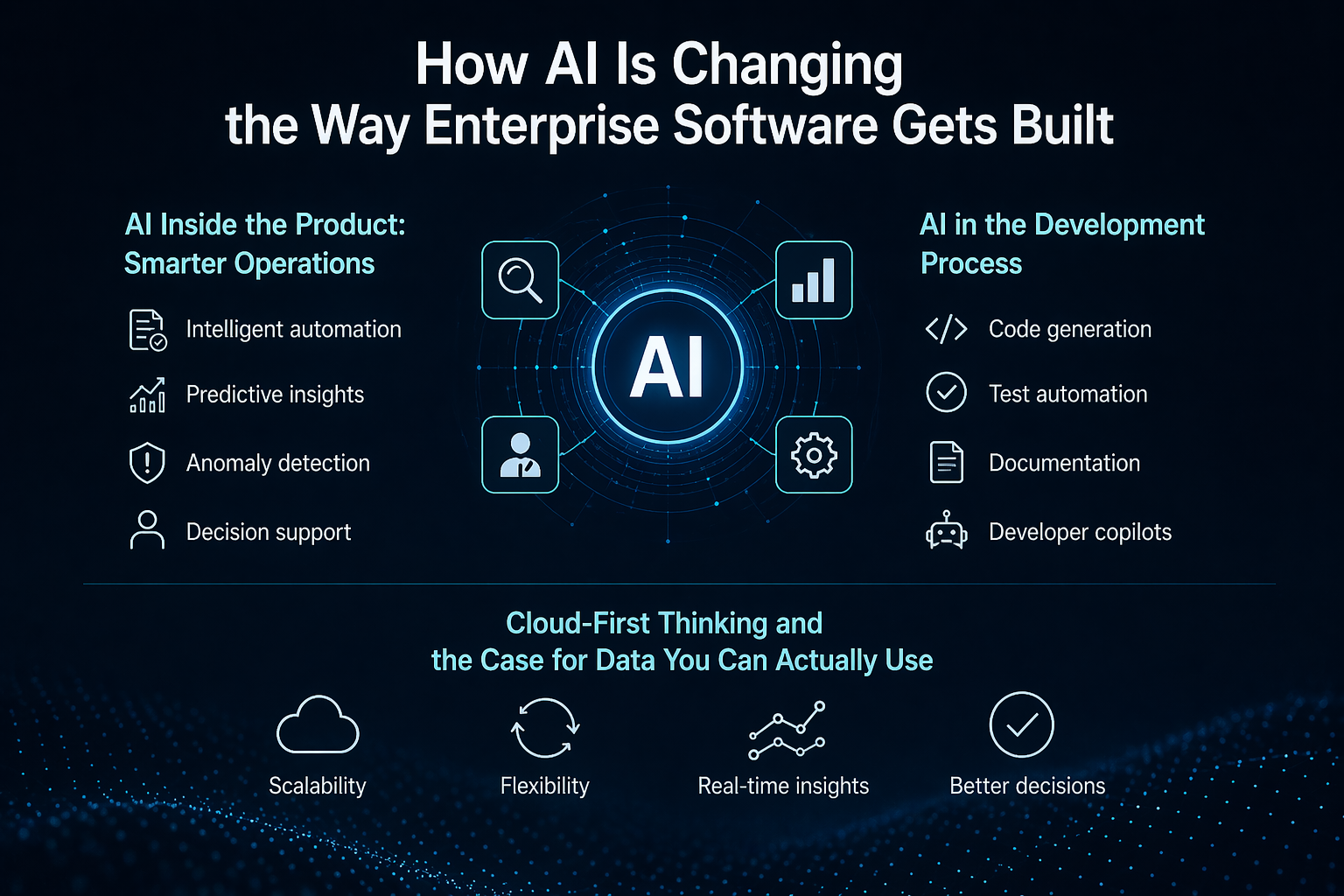
No force is reshaping AI in enterprise software development more dramatically than the current wave of machine learning and generative AI. The change is happening simultaneously at two levels: AI is being embedded inside enterprise systems as an operational capability, and AI tools are transforming how development teams build those systems.
AI Inside the Product: Smarter Operations
Enterprise platforms are getting more sophisticated. Accounts payable teams are utilizing AI to automatically match bills to purchase orders, detecting differences that a human check would overlook. HR systems use natural language processing to resume screening and spot anomalies. Supply chain platforms use predictive models to recommend inventory adjustments before stockouts occur, not after.
The practical effect is a shift away from passive record-keeping and toward active decision support. The best enterprise software today does more than simply save and show data. It identifies insights, highlights hazards, and advises actions when decisions must be taken. This shift alters what users expect from enterprise solutions and increases the bar for all future development projects.
Cloud-First Thinking and the Case for Data You Can Actually Use
Cloud infrastructure changed the economics of enterprise software in ways that are still unfolding. The headline story, lower costs, faster deployment, is real but incomplete. The deeper shift is what cloud-native design does to how teams think about time and scale.
When provisioning a new environment takes minutes instead of weeks, teams develop different instincts. They experiment more. They throw away more. They treat infrastructure as something to be composed and recomposed rather than something to be carefully stewarded over the years.
Enterprise Software Development Cost (2025)
Budget ranges by project scale, development costs only
Primary Cost Drivers
Annual Operating Costs (Post-Launch)
Cloud infrastructure, security audits, licensing, and engineering20–35% of original build cost/year
How Long Does Enterprise Software Development Take
Timeline, like cost, is scope-dependent, but the ranges below reflect real-world delivery experience across enterprise projects of varying complexity:
Simple tools, internal dashboards, single-module applications: 2–4 months
Mid-complexity platforms with integrations and custom workflows: 6–12 months
Full enterprise platforms (ERP, CRM, SCM, industry-specific systems): 12–24+ months
These timelines are based on enough manpower, well-defined needs, and no major design changes. In practice, the three most common reasons for project overruns are scope creep, third-party integration delays, and late-stage stakeholder misalignment.
Teams that spend a rigorous discovery phase, typically four to eight weeks of requirements mapping, user journey design, integration planning, and acceptance criteria documentation before writing a line of code, regularly outperform those that rush into development. Initially, it feels slow. Projects that bypass it usually always regain that time through rework.
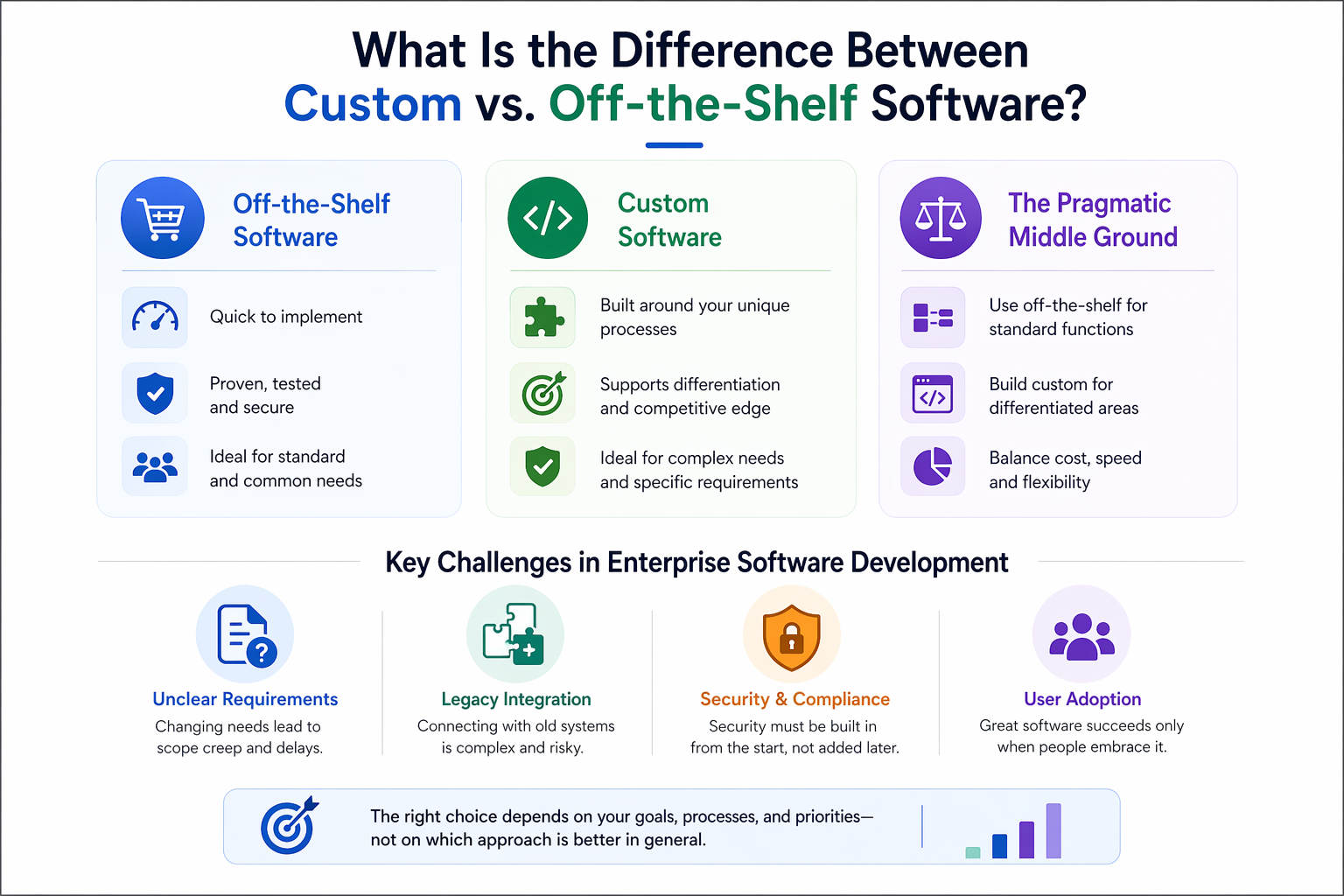
What Is the Difference Between Custom vs. Off-the-Shelf Software?
This is one of the most consequential decisions any organisation makes, and it deserves a genuinely honest answer rather than a default push toward either option.
The Case for Off-the-Shelf
Salesforce, SAP, Workday, and ServiceNow are examples of commercial enterprise platforms that include proven infrastructure, a mature integration environment, vendor-managed security upgrades, and a well-established implementation partner network. For organizations with reasonably conventional processes, these platforms can be delivered faster and for a cheaper initial cost than custom builds. The tradeoff is that you design your processes around the software rather than the other way around. This is entirely fair for routine operations such as general ledger accounting and basic human resources administration.
The Case for Custom Development
Custom software makes sense when your operational processes are genuinely differentiated, and the way your organisation works is a competitive advantage that no commercial platform was designed to support. It also makes sense when compliance requirements impose constraints that generic platforms cannot meet without expensive workarounds, or when the cost of deeply customising an off-the-shelf system exceeds the cost of building something purpose-built.
The Pragmatic Middle Ground
Many sophisticated enterprises use commercial platforms for standard functions while investing in custom development for their most differentiated workflows. A financial services firm might run payroll in Workday while building a proprietary risk-assessment engine. A logistics company might use a standard WMS while custom-developing the routing optimisation layer that drives its competitive advantage. The question is never which approach is inherently superior; it is which approach best serves the specific function you are trying to build.
Enterprise Software Development difficulties
Enterprise software development difficulties that derail projects are rarely technical in nature. They are organised, communicative, and structured. Understanding them in advance is the most practical kind of risk management.
Unclear or shifting requirements
Enterprise systems serve a diverse range of stakeholders, each with their own set of priorities, mental models, and success criteria. Without a rigorous requirements process, scope creep is unavoidable. The answer involves organised discovery, written functional specifications, and a systematic change management approach for mid-project changes.
Legacy System Integration
The majority of businesses don't start from scratch. New systems must connect with older infrastructure pre-dating modern standards. Legacy integration is always the most technically hard and unpredictable phase. Proper API mapping, data transfer planning, and early integration testing are essential for managing this risk.
Security and Compliance
GDPR, HIPAA, SOC 2, and PCI-DSS standards differ by sector, but they all share one need: compliance cannot be retrofitted. Security architecture must be designed from the beginning. Organisations that regard security as a final checklist item frequently discover that retrofitting it costs more.
User Adoption and Change Management
Adoption is not automatic. It necessitates careful change management, including structured training, internal champions, and feedback loops. Organisations that consider deployment as a technological milestone rather than an organisational transformation typically struggle with uptake.
Enterprise Software Development Process
Six phases, what each produces, how long it takes, and what to watch for
Final Thoughts: Building Software That Earns Its Place
The best enterprise software development services does not just automate tasks. It changes what is possible for the organization using it, enabling decisions that could not be made before, eliminating friction that had been accepted as inevitable, and creating capacity for growth that was previously constrained by process.
This enterprise software development guide has covered a lot of ground, from fundamental definitions and cost realities to AI's role in modern development, security architecture, and team hiring. But the thread running through all of it is the same: enterprise software is a strategic investment, not a procurement transaction. It rewards organizations that approach it with clarity, discipline, and a long-term view.
The organizations that get this right compound advantages over time. Their systems improve as their understanding of the business deepens. Their teams develop institutional knowledge that becomes a genuine moat. Their software earns its place not because it was expensive, but because it was built for the right reasons, with the right people, using the right approach.
.png)