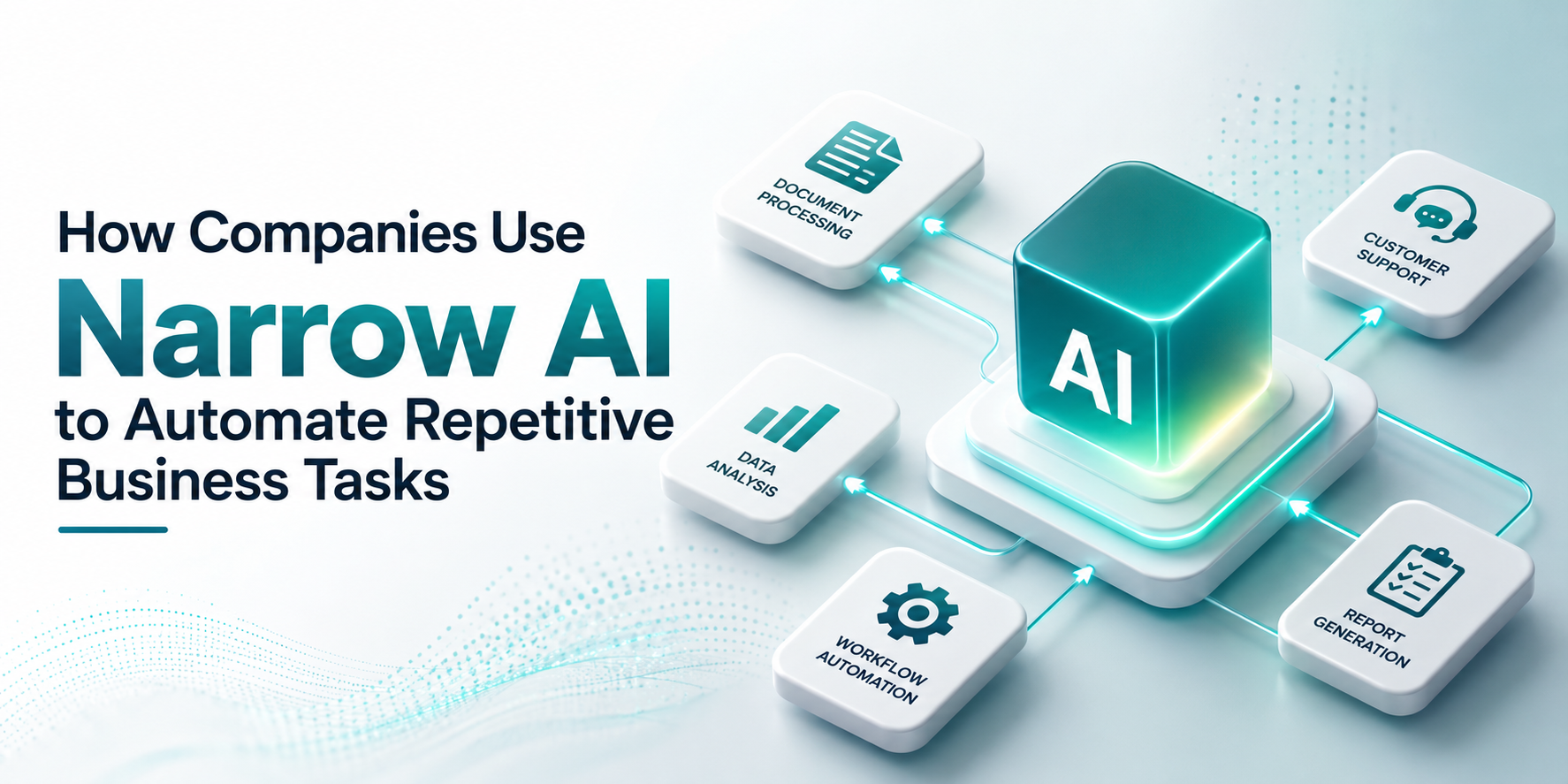

The most effective companies in the world are undergoing a quiet revolution propelled by something far more grounded and immediately potent than the superintelligences of science fiction: narrow AI for business. These targeted, purpose-built systems are silently performing tasks that previously depleted human time, lowered morale, and hindered growth.
One automated procedure at a time, the economic engine of modern business is being rewired, from sorting a thousand bills before lunch to answering consumer enquiries at three in the morning. The majority of executives are now more concerned with how quickly they can use limited AI without losing institutional knowledge or upsetting their staff than with whether or not to do so.
What Exactly Is Narrow AI, and Why Should Business Leaders Care?
Before exploring AI workflow automation in depth, it’s important to understand a distinction that many business leaders often overlook: the difference between Narrow AI and General AI.
While General AI remains largely theoretical, Narrow AI is already a reality and powers many of the technologies businesses and individuals use every day. Also known as Artificial Narrow Intelligence (ANI) or Weak AI, Narrow AI is designed and trained to perform a specific task exceptionally well. Unlike humans, it cannot apply its intelligence across unrelated domains, but within its designated function, it can operate with remarkable speed, accuracy, consistency, and scalability.
A simple example is the spam filter that protects your email inbox. It has no understanding of cooking, music, or creative writing. Its sole purpose is to identify and filter unwanted emails. Yet, it processes billions of messages, makes instant decisions, and continuously improves its accuracy through data and learning. This is Narrow AI in action.
Now imagine that same principle applied across critical business functions such as procurement, human resources, customer service, logistics, sales, and financial reporting. The result is a system capable of automating repetitive tasks, enhancing decision-making, and driving operational efficiency at scale. This is why Narrow AI for business is far more than a passing trend—it is rapidly becoming the foundation of modern competitive enterprises.
The Anatomy of Repetitive Business Tasks
You must first map the geography of repetitive work within an organisation to determine where limited use of AI has the greatest impact. Repetition is not always the same. Others, including demand forecasting, contract clause assessment, and credit risk scoring, are intricate but patterned.
Routine work is divided into two categories by cognitive scientists. Tasks with clear rationale, such as sending an invoice to a senior approver if it exceeds $10,000, are examples of rule-based repetition. Recognise that this customer concern is similar to 14,000 previous complaints and is probably remedied with a refund + a discount coupon. Pattern-based repetition is more subtle.
Narrow AI Use Cases Across Industries
The most instructive way to understand narrow AI use cases is through industry-specific deployments. What follows is a cross-sector survey of how leading organisations are deploying purpose-built AI systems to automate their most labour-intensive processes.
A Closer Look: Accounts Payable Automation in Financial Services
Think of a mid-sized bank that handles 50,000 bills every month. This involved extracting vendor names, invoice numbers, line items, and totals from PDFs, scanned documents, and email attachments, and entering them into the ERP system.
The extraction accuracy reached 97.3% on the first run following the implementation of an Intelligent Document Processing (IDP) solution, which is a limited AI system that combines optical character recognition with a trained NLP model. A human exception queue received the remaining 2.7%. The amount of time spent manually entering data decreased by 89%. The twelve clerks were transferred to spend analysis and vendor relationship management.
AI Workflow Automation: Designing Systems That Actually Work
Understanding use cases is only half the equation. Too many companies rush to automate without first accurately mapping their operations, which leads to AI installations that either solve the incorrect issue or cause new bottlenecks later on.
Regardless of the industry or function, successful AI workflow automation adheres to a predictable design. A trigger (the event that starts the process), a model (the limited AI engine that processes the input), and an action (what happens as a result) are the fundamental components of every automated workflow. The intricacy is found in the connections between these three components and the boundaries that control edge cases.
The Human-in-the-Loop Imperative
Determining where and how human oversight fits into the automated process is one of the most important design choices in any AI workflow automation project. The naive notion is that automation should strive to completely remove human intervention. The more sophisticated and successful perspective holds that human oversight should be maintained in areas where it brings special value, such as accountability for high-stakes results, ethical discretion, judgment under ambiguity, and interpersonal sensitivity.
Because of this, intelligent augmentation systems architectures where AI manages the predictable majority and surfaces the anomalous minority to the most suitable human decision-maker with all the context pre-loaded to enable quick, informed judgment are the most successful narrow AI deployments rather than fully autonomous pipelines.
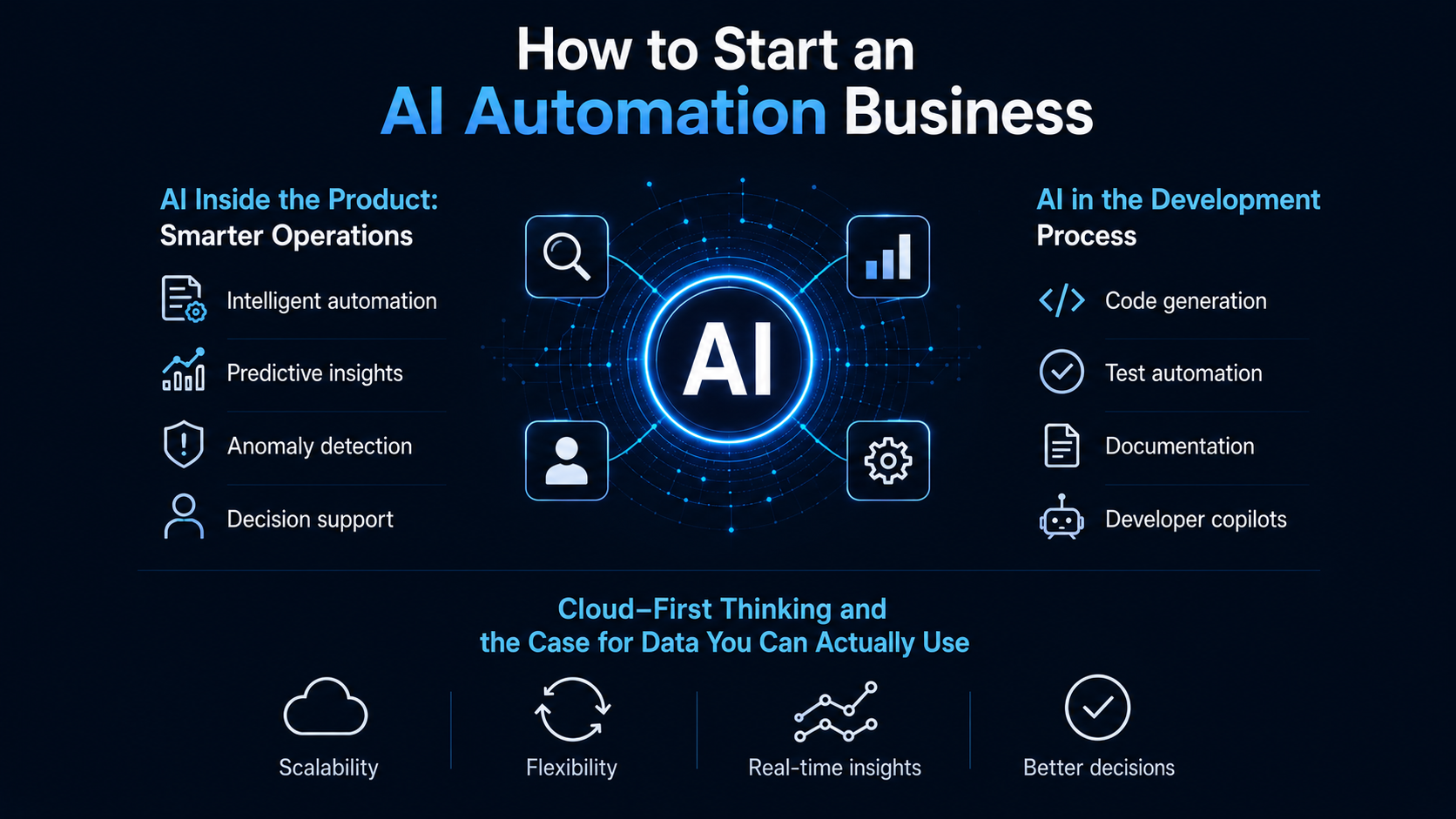
How to Start an AI Automation Business
The surge in enterprise demand for narrow AI for business has created a remarkable commercial opportunity for entrepreneurs and consultants. If you are exploring how to start an AI automation business, the market timing has arguably never been more favourable, but execution discipline separates genuine ventures from poorly conceived experiments.
1. Define a Vertical Before a Technology Stack — Pick one industry you understand deeply. The AI tools are learnable in months; the domain knowledge is the moat.
2. Map the Highest-Cost Repetitive Processes First — Identify the three to five processes that consume the most human hours relative to strategic value. These are your initial automation targets.
3. Build Your First MVP Around a Single Integration — Your first product should automate exactly one process, integrate with one system the client already uses, and reduce a specific metric by a measurable percentage.
4. Price Around Outcomes, Not Hours — Outcome-based pricing, a percentage of verified savings, a per-transaction fee, or a monthly platform fee tied to usage aligns your incentives with client results.
5. Invest in Change Management as Heavily as Technology — Technical implementation rarely fails. What fails is adoption. Include structured change management in every engagement.
6. Build for Explainability From Day One — In healthcare, finance, and legal tech, audit trails and explainable outputs are not nice-to-haves; they are commercial prerequisites.
7. Treat Data Quality as a Product Feature — Narrow AI systems are only as good as the data they operate on. Positioning your business as a data quality partner significantly increases the value you provide.
The Five Pitfalls That Derail AI Automation Initiatives
Automating broken processes. Narrow AI amplifies whatever process it automates, including its inefficiencies. The right sequence is always: simplify first, then automate.
Underestimating integration complexity. The integration layer APIs, data pipelines, authentication, and error handling are often where AI projects spend the majority of their time and budget.
Neglecting model drift. When the business environment shifts, model performance degrades unless actively monitored and periodically retrained. Many organizations invest heavily in initial deployment and almost nothing in ongoing model governance.
Overlooking ethical and compliance dimensions. In domains like recruitment, lending, and healthcare, narrow AI systems can encode and amplify historical biases present in their training data.
Failing to measure the right outcomes. Build your measurement framework before you build your automation, not after.
The Road Ahead: What the Next Phase of Narrow AI for Business Looks Like
The trajectory of narrow AI for business points clearly toward two concurrent developments: expanding capability and deepening integration. On the capability frontier, narrow AI systems are becoming increasingly effective at tasks that once required genuine contextual understanding, multi-step document reasoning, nuanced sentiment analysis, and complex scheduling with multiple competing constraints.
On the integration frontier, end-to-end automation of procedures that previously required human coordination across numerous tools and teams is made possible by the emergence of agentic AI frameworks, which are systems where numerous narrow AI components collaborate in coordinated pipelines.
Business executives have a clear strategic imperative: over the next ten years, companies that build internal expertise in recognising, designing, and regulating AI workflow automation will increase their operational advantages. There is a window of opportunity for businesses to use limited AI to differentiate themselves from competitors, but it won't last forever
.png)