
Running large language models in production is no longer just a technical challenge it is a financial one. Between late 2024 and mid-2025, global LLM API spending doubled from $3.5 billion to $8.4 billion. Enterprise AI teams are now watching their monthly inference bills exceed $250,000, and in poorly optimized systems, costs spiral 2x–4x beyond projected budgets within the first year of scale.
Running large language models in production is no longer just a technical challenge it is a financial one. Between late 2024 and mid-2025, global LLM API spending doubled from $3.5 billion to $8.4 billion. Enterprise AI teams are now watching their monthly inference bills exceed $250,000, and in poorly optimized systems, costs spiral 2x–4x beyond projected budgets within the first year of scale.
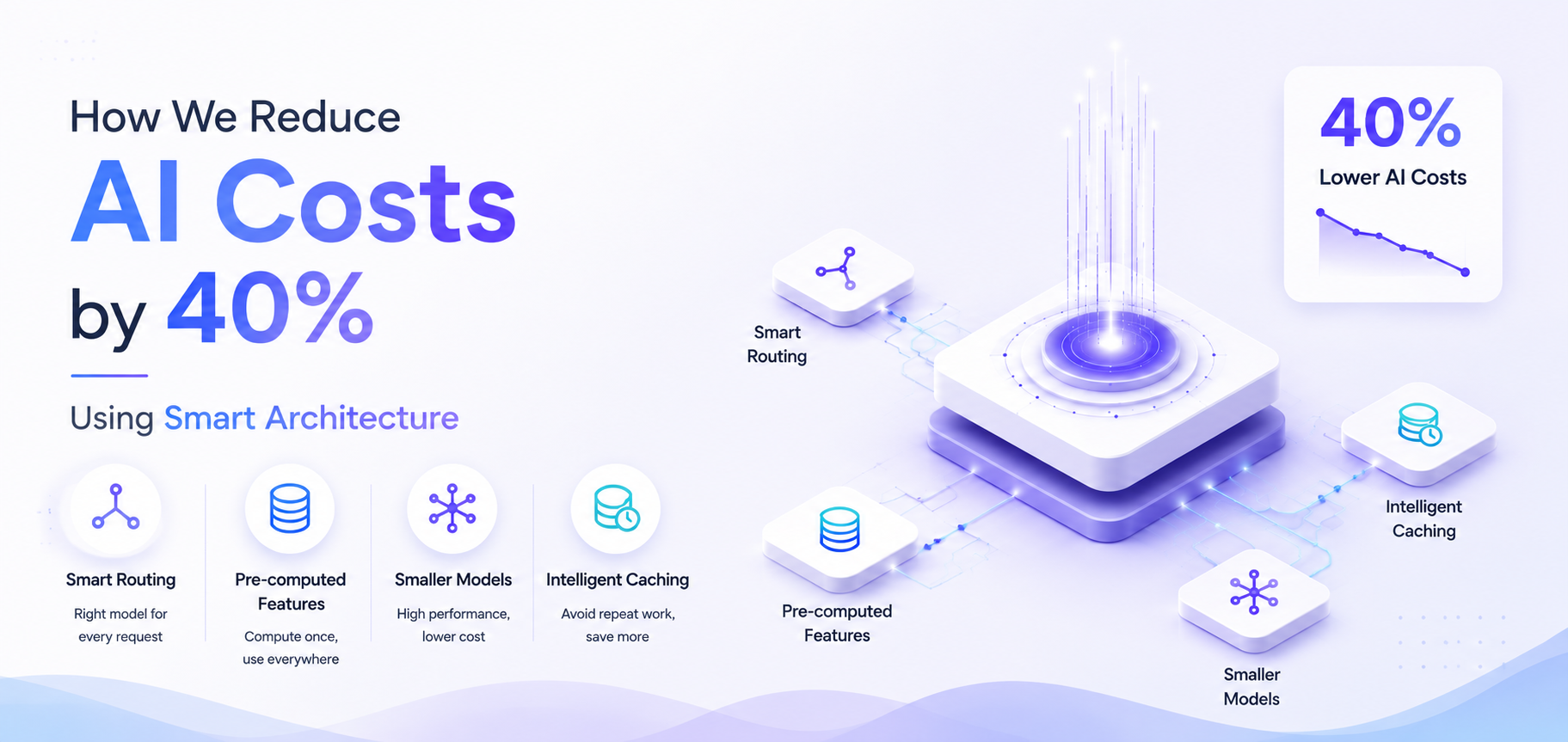
The good news? LLM cost optimization is not only achievable, but it is also measurable, repeatable, and in many cases delivers reductions of 47% to 80% without any noticeable degradation in output quality. In this guide, we break down every major strategy for cutting LLM costs in production, from prompt caching and model routing to geographic deployment and model selection, including which models are most in demand, which country offers the cheapest infrastructure, and which LLM is the best fit for specialized use cases like financial analysis.
Whether you are an MLOps engineer managing inference infrastructure, a product leader trying to hit margin targets, or a CTO building AI into your core product, this is the 2026 playbook you need.

Why LLM Costs Explode in Production
Most teams experience sticker shock not during prototyping but at scale. What costs $200/month in a pilot environment can cost $200,000/month in production. Understanding why costs compound is the first step to controlling them.
There are two distinct cost categories that organizations frequently undercount
LLM development cost covers everything that happens before a model reaches users, fine-tuning, training runs, evaluation pipelines, prompt engineering iterations, data preparation, and the engineering hours involved in building the surrounding infrastructure. For organizations fine-tuning a 7B–13B parameter model, development costs typically range from $5,000 to $50,000, depending on compute choices and iteration depth. Many teams underestimate this phase because the costs are distributed across salaries, cloud compute, and storage rather than appearing as a single line item.
LLM deployment cost is where the real surprise hits. Deployment costs include inference compute, API call volume, token throughput, context window size per call, output token generation, vector database queries, load balancing, observability tooling, and data egress. At enterprise scale where tens of millions of tokens are processed daily these costs stack fast. A single poorly-designed system prompt that adds 500 unnecessary tokens to every API call can cost an organisation $40,000+ per month in wasted spend.
The total cost picture is therefore always larger than the API bill alone. Before implementing any optimisation strategy, map your full cost stack across development, deployment, storage, and infrastructure. You cannot optimize what you cannot model.
What Are the 4 Types of LLM?
Before choosing an optimisation strategy, it helps to understand the model's architecture class, because cost profiles differ dramatically across types.
1. Foundation models (base LLMs): These are large, general-purpose models trained on broad internet-scale data. Examples include GPT-4o, Claude 3.5 Sonnet, and Gemini 1.5 Pro. They are the most capable but also the most expensive to query, with costs ranging from $2 to $15 per million tokens depending on the provider and context window used.
2. Instruction-tuned models: Fine-tuned versions of foundation models that follow natural-language instructions reliably. GPT-4o-mini, Claude 3 Haiku, and Gemini Flash fall into this category. These models are 5x–20x cheaper per token than their parent models and are the primary routing destination in cost-optimised production systems.
3. Domain-specific fine-tuned models: Models further trained on specialised corpora: legal documents, medical records, financial filings, code repositories. These models often outperform much larger general models on narrow tasks while running at a fraction of the cost. A fine-tuned Mistral 7B on your internal knowledge base may outperform GPT-4o on your specific task while costing 95% less per query.
4. Locally-hosted / open-source models: Models such as LLaMA 3, Mistral, Phi-3, and Gemma run on your own infrastructure. While the upfront compute cost is real, per-query marginal cost drops to near zero at sufficient scale. For high-volume, latency-tolerant workloads, self-hosted open-source models offer the most dramatic long-term cost reduction.
Understanding which type you are using and whether that type is the right type for each task is foundational to every LLM cost 2026 strategies framework.
How Have We Reduced LLM Costs by 90%?
This question is asked more and more by engineering teams as production bills mount. The answer is never a single trick; it is a compounding stack of techniques applied in sequence.
Here is the framework that consistently delivers 70–90% cost reduction in production
Step 1: Prompt caching (saves 45–80%)
When your application delivers a system prompt to an LLM, the model reprocesses it from scratch. This is expensive and wasteful for system prompts with hundreds or thousands of tokens.
Prompt caching caches the processed key-value (KV) state of static prompt prefixes, allowing subsequent searches to reuse computation. Anthropic's Claude API, for example, provides quick caching, which reduces input token costs by up to 90% on cached material while improving time-to-first-token by 13-31%. Prompt caching should be the first optimization implemented in any program where the system prompt changes less frequently than user enquiries, which is practically all applications.
Step 2: Semantic caching (saves a further 30–50%)
Standard caching only produces identical replies for byte-identical queries. Semantic caching employs vector embeddings to discover semantically identical queries, even when written differently. According to recent research, 31% of enterprise LLM searches are semantically comparable to earlier ones. By storing query embeddings and responses, a semantic cache based on Redis LangCache may deliver those 31% of queries in milliseconds, skipping the API call entirely.
One production implementation of semantic caching achieved a 90% cache hit rate while reducing costs by 80% across OpenAI, Claude, and Gemini. Latency fell from 1.67 seconds per request to 0.052 seconds on cache hits, representing a 96.9% improvement.
Step 3: Model routing (saves 37–46%)
Not all queries require GPT-4o. A query like "summarise this paragraph in three bullet points" takes significantly less thinking capacity than "analyze the financial risk profile of this merger agreement." Model routing sorts incoming queries by complexity and sends them to the cheapest model that can do the task sufficiently.
A well-tuned routing layer directs 60-70% of production traffic to tiny, low-cost models while reserving large models for truly difficult queries. The end result is a 37-46% decrease in average cost-per-query with no discernible change in user-perceived quality.
Step 4: Batching and concurrency optimization (saves 10–25%)
LLM APIs are most efficient when queries are batch processed. Sending 100 short queries in succession is substantially more expensive than batching them in groups of 10-20, particularly for background processing tasks such as document analysis, data extraction, or content development pipelines. Most major providers, including OpenAI and Anthropic, offer async batch APIs at a 50% cost savings over real-time inference.
Combined, these four layers represent the full LLM cost optimization stack. Teams that implement all four consistently achieve 70–90% reductions in production spend.
LLM Cost 2026 Strategies: The Three-Pillar Framework
The most effective LLM cost 2026 strategies share a common structure regardless of provider, model family, or use case. They are organized around three pillars Cache, Route, and Compress.
Pillar 1: Cache strategically
Caching operates at two levels: prompt-level (using provider-native prompt caching) and response-level (using semantic caching at the application layer). Both should be deployed simultaneously. The highest-ROI caching targets are:
System prompts longer than 1,024 tokens
RAG context blocks that appear repeatedly across user sessions
FAQ-type queries that recur across your user base
Document analysis tasks where the same document is queried multiple times
Pillar 2 : Route intelligently
Intelligent routing requires two components: a classifier that assesses query complexity, and a model registry that maps complexity levels to cost-appropriate models. The routing decision should happen in under 50 milliseconds to avoid adding perceived latency.
Routing tiers in a well-designed system look like this:
Pillar 3: Compress aggressively
Token compression involves reducing the size of every prompt without reducing the quality of the output. Techniques include:
Replacing verbose system instructions with structured, concise equivalents
Truncating RAG context to the most semantically relevant chunks only
Using structured output formats (JSON, markdown tables) to reduce output verbosity
Removing a few redundant examples once the model performs reliably
A well-compressed prompt typically achieves the same output quality at 30–50% fewer tokens: translating directly to 30–50% lower API costs on every single call.
Which LLM Is Most in Demand?
Understanding the demand landscape helps both in vendor negotiation and in anticipating which models will see price reductions as competition intensifies.
As of early 2026, the most in-demand LLMs by production usage volume are:
GPT-4o and GPT-4o-mini (OpenAI) : continue to lead enterprise adoption, primarily because of their broad API ecosystem, reliable uptime, and fine-tuning support. GPT-4o-mini in particular has seen explosive adoption as a default routing target for cost-sensitive workloads.
Claude 3.5 Sonnet and Claude 3 Haiku (Anthropic) : are the leading alternatives in enterprises with strong compliance and safety requirements. Claude models are particularly dominant in legal tech, healthcare, and financial services, where output reliability is paramount.
Gemini 1.5 Pro and Gemini Flash (Google) are gaining rapidly in organizations already embedded in the Google Cloud ecosystem, especially for use cases requiring large context windows (up to 2 million tokens) at competitive pricing.
LLaMA 3 and Mistral (open source) are the most in-demand models among teams building for cost efficiency at scale, where self-hosting or using managed open-source inference platforms like Together AI or Fireworks AI offers the lowest marginal cost per query.
The demand trend for 2026 is clearly toward hybrid deployments: using a foundation model API for complex tasks and a self-hosted open-source model for high-volume, simpler workloads.
Which Country Is the Cheapest for LLM?
Geographic infrastructure decisions have a surprisingly large impact on LLM deployment cost, particularly for teams self-hosting models or building on top of cloud compute rather than managed APIs.
As of 2026, the cheapest regions for LLM inference infrastructure are:
India (AWS ap-south-1 / Azure Central India) offers among the lowest GPU spot instance pricing globally, with A100 instances available at 35–45% below US East pricing. India's rapidly expanding data centre footprint and competitive cloud market make it the top choice for APAC-focused teams.
Poland and Eastern Europe (Azure Poland Central / OVHcloud) represent the most cost-effective region within the EU, offering GPU compute at 20–30% below Western European pricing while remaining within GDPR jurisdiction, critical for European enterprise deployments.
US East (Virginia) remains the lowest-cost major US region due to the density of data centre infrastructure, though the gap with offshore regions is narrowing as overseas capacity expands.
Chile and São Paulo (AWS sa-east-1) are increasingly attractive for Latin American workloads, with spot GPU pricing competitive with US East for inference tasks.
The most important cost lever beyond raw compute pricing is data residency and compliance requirements. Regulatory constraints, particularly under the EU AI Act, India's DPDP Act, and emerging national AI frameworks, may restrict where your inference infrastructure can legally sit, overriding pure cost considerations. Always map your compliance obligations before optimizing for geography.
What Is the Best LLM for Financial Analysis 2026?
Financial analysis represents one of the most demanding LLM use cases: it requires numerical reasoning, regulatory awareness, document-length context handling, and output reliability that is far above casual conversation thresholds.
The top-performing models for financial analysis use cases in 2026 are:
Claude 3.5 Sonnet / Claude Opus 4: Anthropic's models consistently outperform peers on long-document financial analysis, regulatory filings, and structured data extraction. The models' low hallucination rate on numerical content makes them the preferred choice in fintech and investment management contexts.
GPT-4o with structured outputs: OpenAI's structured output mode, which constrains model responses to a predefined JSON schema, is particularly valuable in financial applications where output format consistency is non-negotiable. GPT-4o's function-calling capability integrates cleanly with financial data APIs.
Bloomberg GPT (domain-specific): For organizations in capital markets, Bloomberg's purpose-built financial LLM, trained on Bloomberg's proprietary financial data corpus, outperforms general models on financial entity recognition, market terminology, and earnings report analysis.
Fine-tuned Mistral 7B on internal financial data: For organizations with significant historical financial documents (loan applications, investment memos, compliance reports), a fine-tuned open-source model will outperform general models on institution-specific tasks at a fraction of the ongoing API cost.
The optimal LLM cost 2026 strategies for financial analysis teams is a two-tier architecture: use a fine-tuned smaller model for routine extraction and classification tasks (transaction categorization, document parsing, data normalization), and route only the genuinely complex analytical tasks (portfolio risk assessment, M&A due diligence summaries, regulatory interpretation) to a frontier model.
Hidden Costs That Blow Up LLM Budgets
Beyond API token costs, four cost categories consistently catch teams off-guard at scale:
Vector database costs: Every RAG-based application depends on a vector database (Pinecone, Weaviate, pgvector) for context retrieval. At scale, storage costs, query volume charges, and index rebuild costs can add $5,000–$30,000 per month to infrastructure spend. Optimize by using approximate nearest-neighbour (ANN) search, reducing embedding dimensions where possible, and archiving low-frequency knowledge base content.
Observability and evaluation tooling: Production LLM systems require monitoring for quality, cost, and latency simultaneously. Tools like Langfuse, Helicone, and Arize Phoenix are essential but carry usage-based pricing that scales with request volume. Budget 5–10% of your inference spend for observability tooling, it is the investment that makes every other optimization measurable.
Output token bloat: Input tokens are processed in parallel (fast and relatively cheap). Output tokens are generated sequentially (slow and expensive). Verbose responses with unnecessary context, repetition, or decoration cost 3–5x more in latency and money than concise equivalents. Prompt engineering to constrain output format and length is one of the highest-ROI LLM cost optimization interventions available.
Re-ranker and embedding model costs: Multi-stage RAG pipelines often include a re-ranker model that scores candidate context chunks before sending them to the primary LLM. While individually cheap, re-ranker calls at scale add up. Evaluate whether your re-ranker is actually improving output quality at the margin; many applications perform equivalently with a well-tuned vector search alone.
Building a Cost Governance Framework for LLM in 2026
Cost optimization is not a one-time project: it is an ongoing operational discipline. The organizations achieving sustained cost control in 2026 treat LLM spend like cloud compute: with budgets, alerts, attribution, and accountability.
A mature LLM cost optimization governance framework includes:
Feature-level cost attribution: Know exactly how much each product feature costs to run per user, per request, and per month. Without this, you cannot prioritize optimization efforts or justify infrastructure investments to stakeholders.
Token budget policies: Set hard limits on input and output token counts per request type. Enforce these programmatically at the API gateway level, not just as guidelines for developers.
Cost anomaly detection: Set automated alerts for request volume spikes, unusual output length growth, or sudden changes in cost-per-query. Undetected prompt injection attacks or runaway agent loops can generate $50,000+ in unexpected spend overnight.
Quarterly model review cycles: The LLM pricing landscape in 2026 moves fast. A model that was the cheapest option for your use case six months ago may have been undercut by a newer release. Review your model selection quarterly against updated benchmarks and pricing tables.
A/B testing for cost-quality tradeoffs: Before routing a class of queries to a cheaper model, run controlled experiments measuring output quality on a held-out evaluation set. Track cost reduction and quality delta simultaneously.
Recommended Tools for LLM Cost Optimization in 2026
These are the platforms and frameworks most widely adopted by production teams in 2026:
LLM Cost Optimization Checklist: Quick Wins vs Long-Term Projects
Quick wins (implement this week)
Enable prompt caching on all static system prompts longer than 500 tokens
Switch simple classification and extraction tasks to GPT-4o-mini or Claude Haiku
Set output token limits on every API call
Enable async batch processing for all non-real-time workflows
Deploy Langfuse or Helicone for cost visibility before optimizing anything else
Medium-term projects (1–3 months)
Implement semantic caching with vector embeddings
Build a complexity-based model routing layer
Audit and compress all system prompts across your application
Implement feature-level cost attribution dashboards
Long-term projects (3–12 months)
Fine-tune a domain-specific, smaller model for your highest-volume task categoryEvaluate self-hosting open-source models for appropriate workloads
Build cost anomaly detection and alerting infrastructure
Establish a quarterly model review and benchmarking process
The Bottom Line: What to Prioritize First
The combination of prompt caching, semantic caching, and model routing delivers 47–80% cost reduction with relatively low implementation effort, and it is where every production optimization programme should start. The advanced tactics (fine-tuning, self-hosting, geographic arbitrage) compound these gains further but require more engineering investment.
The most important principle across all LLM cost 2026 strategies is that you cannot optimize what you cannot measure. Before implementing a single technique, deploy observability tooling, so you have a cost baseline to measure against. Everything else follows from that.
LLM pricing will continue to fall in 2026 as model efficiency improves and competition intensifies. But the organizations that build systematic cost governance now will maintain margin advantages long after commodity pricing arrives, because optimization discipline compounds, and the habits built today will scale with every order of magnitude of growth that follows.
.png)