
Every business leader today faces the same pressure: how do you harness the power of artificial intelligence without getting lost in the noise? Whether you're searching for how to build an AI app , evaluating an AI app builder, or planning a full-scale enterprise AI development project , this guide covers everything.
At Codezilla, we've built AI-powered applications across healthcare, logistics, legal tech, e-commerce, and manufacturing. This article is our complete playbook from the fundamentals of artificial intelligence to the exact AI development process we follow for every client.
Traditional App vs. AI App
One of the most common questions we hear from business leaders is: 'Our current app works fine, why do we need AI?' The answer lies in what AI enables that traditional software structurally cannot.
Artificial Intelligence Applications in Business
➤Predictive Maintenance: An AI app development company builds intelligent systems for factories that analyse machine data to predict potential failures. This helps businesses prevent costly downtime and improve operational efficiency.
➤Personalised Recommendations: An AI app development company creates smart recommendation engines for e-commerce and software platforms, suggesting products or content based on user behaviour and preferences.
➤Fraud Detection & Risk Scoring: Financial institutions rely on solutions developed by an AI app development company to detect unusual transactions in real time and assess risk with high accuracy.
➤HR & Recruitment Automation: Many organisations partner with an AI app development company to automate hiring processes, from resume screening to candidate matching and interview scheduling.
➤Sales Intelligence: With tools designed by an AI app development company, businesses can analyse customer interactions like calls and emails to get real-time insights and improve sales strategies.
➤Healthcare Diagnostics: An AI app development company develops advanced diagnostic systems that analyse medical images, helping doctors detect diseases earlier and with greater consistency.
Most AI development teams view deployment as the final step. That's not the case. Deployment is where the hard work begins. AI programs in production encounter issues that no test environment can adequately imitate, such as edge situations in real-world user behaviour, model drift over time, cost overruns from unchecked token usage, and scaled latency bottlenecks.
Step 7 is our most detailed operational discipline, since it determines the difference between a demo and a dependable product.
 How We Build an AI App
Building an AI app development solution differs from creating regular software. The stakes are higher, dependencies are more complex, and failure modes are unique. Many companies trying to “add AI” fail not because AI is ineffective, but because they skip critical steps in the AI app development process.
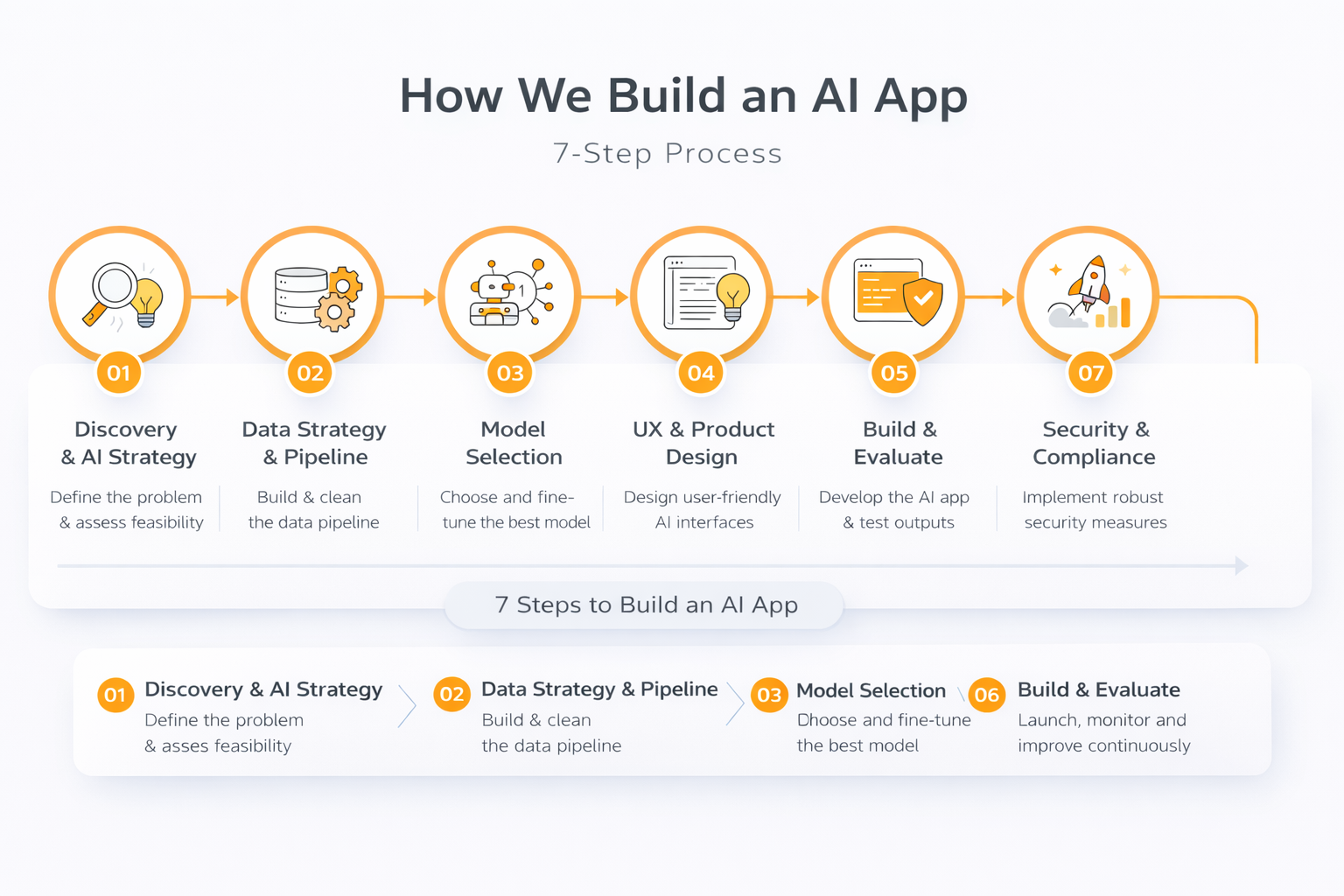
Through hundreds of engagements with enterprises and startups, Codezilla has refined a proven 7-step AI app development approach. Each step is detailed, battle-tested, and backed by real-world project experience.
Step 01
Discovery & AI Strategy
Define the problem before you write a single line of code
At Codezilla, we’ve seen teams rush into tools without fully understanding the problem. That’s why we slow things down first. This is where the real thinking happens.
Do you even need AI? We challenge the idea early. If a simpler solution can solve it faster and cheaper, we’ll be honest about it.
Everything ties to business impact: We define clear goals, whether it’s saving time, increasing conversions, or driving revenue, so every decision has purpose.
We align everyone from day one: Getting stakeholders on the same page early helps avoid confusion and delays later.
We assess your data properly: We audit your data to check quality and gaps. If something’s missing, we tell you what needs fixing before moving ahead.
We build for reality, not hype: We choose the right architecture based on your actual needs, budget, and scale, focusing on what works in production.
This step may feel slower, but it prevents costly mistakes and sets the foundation right.
Step 02
Data Strategy & Pipeline Architecture
Your AI is only as intelligent as the data that feeds it
Data is the foundation of every AI-powered app. Businesses often underestimate the amount of engineering work required before any model training or integration begins. Step 2 is where we build the infrastructure that will determine 80% of your AI app's real-world quality.
Phase A — Data Audit & Classification
➤We identify and classify structured, unstructured, and semi-structured data.
➤We separate proprietary business data from public sources to uncover the true competitive advantage.
➤Each dataset is assessed for quality, gaps, and preprocessing requirements.
Phase B: Data Cleaning and Standardisation
➤We remove duplicate records and handle missing values.
➤We standardise formats across all systems to create consistency.
➤Outliers are detected early to avoid distorted outputs.
➤Sensitive information and PII are masked before data reaches the model layer.
Phase C — Vector Embedding & Database Setup
For an AI generative app that requires semantic search or RAG (Retrieval-Augmented Generation), we convert text data into numerical vector representations and store it in a vector database that the system can efficiently query during inference.
Codezilla determines the optimal chunking strategy to improve retrieval accuracy.
We select embedding models based on content, language, and use case.
Vector databases are used for fast, scalable semantic search.
Metadata is added to each data chunk to enhance precision and context-awareness.
Data Pipeline Tools We Use
Apache AirflowdbtPinecone / pgvectorGreat ExpectationsLangChain / LlamaIndex
Step 03
Model Selection & Integration
Choosing the right AI engine for your specific problem
This is where most businesses make their biggest mistake: choosing the most famous model rather than the right model. GPT-4 is not always the answer. In this step, we systematically evaluate model options against your specific use case, budget, latency requirements, and data privacy constraints.
➤Use Case FitCodezilla maps the problem to the right model type, whether it’s generation, summarisation, extraction, or analysis.
➤Model Selection (Open vs Proprietary)We evaluate both proprietary models and open-source options to balance performance, control, privacy, and cost.
➤Right Optimisation StrategyDepending on the use case, Codezilla applies fine-tuning, RAG, or prompt engineering — choosing what delivers the best results efficiently.
➤Deployment Choice (Cloud vs On-Prem)We select the right setup based on compliance, scalability, and infrastructure needs.
➤Context HandlingCodezilla ensures the model can handle the required input size without losing critical information.
➤Cost EfficiencyWe model cost-per-token and usage patterns upfront to avoid unexpected scaling costs.
Model selection isn't about choosing the most powerful option; it's about selecting the most appropriate one.
Step 04
UX & Product Design for AI
Design that makes users trust the AI — not fear it
AI UX is a discipline most design teams have never practised. Designing for an AI-powered app requires principles that don't apply in traditional software design, because the output is probabilistic rather than deterministic. Users need to know when to trust the AI, when to question it, and always how to override it.
How Codezilla addresses the AI UX:
➤Trust Indicators:Every output includes unambiguous confidence signals and source context to establish user trust.
➤Fallback Design:The system provides alternatives, sources, or escalation paths instead of dead ends. This is known as progressive disclosure. Simple responses first, with deeper insights available on demand.
➤Human in the Loop:Human control is maintained by approval flows, review queues, and override controls. The system is also explainable. Users may understand how decisions are made, especially important for regulated use cases.
➤Error Handling:We plan for AI-specific hazards such as hallucinations, rather than just system faults.
Prototyping & Usability Testing for AI Apps
We run AI-specific usability tests before any production code is written:
➤Simulate AI behaviour before models are ready (Wizard of Oz)
➤Test how users trust and interact with AI outputs
➤Introduce controlled errors to study user response
➤Optimise how much explanation users actually need
AI UX isn’t just design — it’s about building trust, clarity, and control into every interaction.
Step 05
Build, Evaluate & Iterate
The development cycle is purpose-built for AI, not borrowed from traditional software
A common mistake in AI development is treating it like traditional software. Unit tests can’t catch hallucinations, and fast sprint cycles don’t guarantee model quality. This stage necessitates a distinct engineering approach, in which evaluation is central to growth.
The AI Development Stack
Prompt StudioVersion ControlEval FrameworkHallucination DetectorA/B Testing Engine
How Codezilla Approaches It: Prompt Engineering and Versioning
➤Prompts in CodePrompts are viewed as essential logic, and even minor modifications can drastically affect output quality.
➤Version ControlEvery prompt is tracked with versions, changes, and ownership, similar to source code.
➤Dynamic PromptingPrompts are designed with variables to adapt to diverse users, settings, and inputs.
➤Regression TestingEvery update is evaluated against a huge evaluation set to ensure no performance reduction.
➤Layered prompt designPrompts are structured into obvious layers: persona, task, format, and safety, and each is separately optimised.
In AI systems, prompts are more than just inputs; they serve as the application's control layer.
The Evaluation Framework (Evals)
Evals are automated tests for AI behaviour. Every AI app we build ships with a comprehensive eval suite:
Factual accuracy evals: does the AI answer correctly against ground truth?
Hallucination detection: does the AI generate content not supported by source documents?
Instruction following: does the AI respond in the requested format and length?
Tone and persona consistency: does the AI maintain the correct voice across edge cases?
Safety evals: does the AI refuse appropriately harmful or out-of-scope requests?
Latency benchmarks: does the AI respond within SLA limits under load?
Regression tests: do new model versions maintain quality baselines?
Step 06
AI Security, Governance & Compliance
The layer that separates production-grade AI from dangerous prototypes
This is the most overlooked and perilous stage of AI development. AI systems pose new security concerns and compliance difficulties that previous frameworks can not completely address.
Our Security Approach: AI-specific threat protection
➤Prompt injectionWe prevent harmful instructions from influencing model behaviour.
➤Data leakage (exfiltration)Safeguards prevent sensitive data from being retrieved through creative prompting.
➤Model poisoningInput validation and restricted learning pipelines ensure model integrity.
➤Retrieval SecurityContent pipelines are secured to prevent manipulation of retrieved information.
Compliance & Governance
➤ Healthcare (HIPAA)
Ensuring PHI protection, secure access, and audit logging
➤ Enterprise Standards (SOC 2)
Strong access control, monitoring, and change management
➤ EU AI Act
Risk classification, transparency, and human oversight built in
➤ Privacy Regulations (GDPR/CCPA)
Data minimisation, consent management, and right-to-erasure protocol
Step 07
Deployment, Monitoring & Continuous Improvement
Shipping is the beginning, not the end
Most teams treat deployment as the finish line. In reality, it’s where AI systems are truly tested. Once live, AI apps face real-world challenges, unpredictable user behaviour, model drift, rising costs, and latency at scale.
Production Deployment Architecture
➤Streaming Responses:Responses are streamed token-by-token to reduce perceived latency and improve UX.
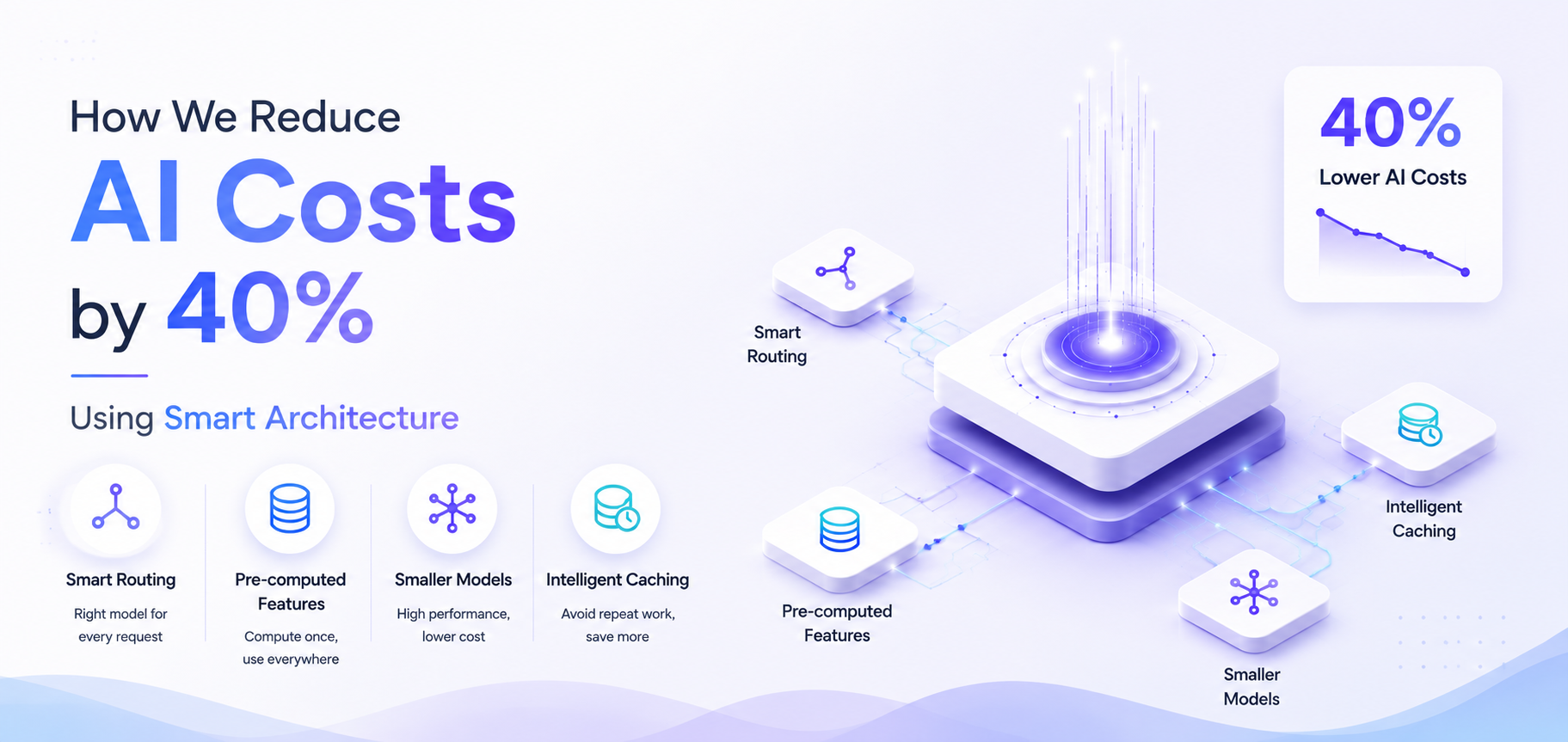
➤Semantic Caching:Repeated or similar queries are served from cache, significantly reducing cost and load.
➤Async Processing:Heavy tasks run in the background with progress tracking — no blocking or delays for users.
➤Scalable Infrastructure:Traffic is distributed across multiple endpoints with automatic failover for reliability.
➤Shadow Deployments:New model versions are tested in parallel before going live, ensuring zero-risk updates.
30–50%Cost reduction from semantic caching
60–80%Perceived latency reduction via streaming
3–4xPrompt compression achievable
Cost Optimisation in Production
Uncontrolled inference costs are the silent killer of AI projects. We've seen companies spend 0K/month on model API calls that should cost 2K with proper optimisation:
Token budget enforcement: system prompts, retrieved chunks, and conversation history are all token-capped to prevent runaway costs.
Model routing: simple queries route to cheap models (Haiku, GPT-3.5), complex queries route to expensive models (Claude 3.5 Sonnet, GPT-4o).
Batch processing: non-urgent workloads are batched and processed during off-peak hours at lower API rates.
Prompt compression: we apply LLMLingua or similar techniques to compress long prompts by 3–4x without accuracy loss.
Retrieval precision tuning: retrieve 3 highly relevant chunks rather than 10 medium-relevance chunks: reduces tokens, increases accuracy.
The 7-Step AI Development Process — At a Glance
AI vs. Manual: The Real Cost Difference
One of the most common objections to AI app development is cost. 'It seems expensive.' But the better question is: what is it costing you NOT to build AI? Let's break down the numbers across three scenarios.
7-step AI development process: tools guide
Recommended AI tools for each stage of building an AI-powered application

Conclusion
Building applications with Artificial Intelligence is not about updating technology; it is something that modern companies really need to do. Artificial Intelligence can change how companies work, compete with others, and grow by automating things in a way giving us ideas about what might happen and making user experiences personal.
But being successful with Artificial Intelligence is not about using the newest models; it is about taking a careful approach that looks at the whole process, including describing the problem, making sure the data is good, choosing the right model, making sure users trust it, and always trying to get better.
.png)