
Every fintech founder eventually stares at the same bill: a cloud infrastructure invoice that doubles each quarter, an AI model that costs more to run than the feature generates in revenue, and a compliance remediation budget that was never on the original roadmap.
The fintech apps that grow profitably in 2026 are not built on bigger budgets. They are built on a smarter architecture. At our fintech app development company, we have documented a repeatable approach that consistently reduces AI and infrastructure operating costs by 40% while simultaneously improving security posture, compliance readiness, and product velocity. This article explains exactly how and gives you the frameworks, timelines, and cost benchmarks you need to make informed decisions about your own build.
What Regulations Does a Fintech App Need to Comply With in 2026?
The compliance landscape is the first thing any credible fintech app development process must map before architecture, before a single line of code. In 2026, eight frameworks collectively govern the vast majority of fintech products globally. Understanding which apply to your product, in which market, and when you need them determines your entire security and audit architecture.
The table below is the starting point we use with every client in week one of discovery:
The 2026 Additions: AI Governance and Open Banking
Two regulatory areas matured significantly in 2025 and now affect every fintech app development company building AI-powered financial products. The EU AI Act's high-risk classification for credit scoring, fraud detection, and insurance pricing models is now in force, requiring conformity assessments, bias audits, and human oversight mechanisms. In parallel, India's DPDP Act 2023 and the UK's Smart Data schemes have tightened consent management requirements, directly affecting how you design your onboarding and data pipeline architecture.
The practical implication: if your fintech app uses any machine learning model to make or influence a financial decision about a consumer, build your explainability and audit infrastructure before the model, not after it.
How Much Does It Cost to Build a Fintech App? (MVP to Full Product)
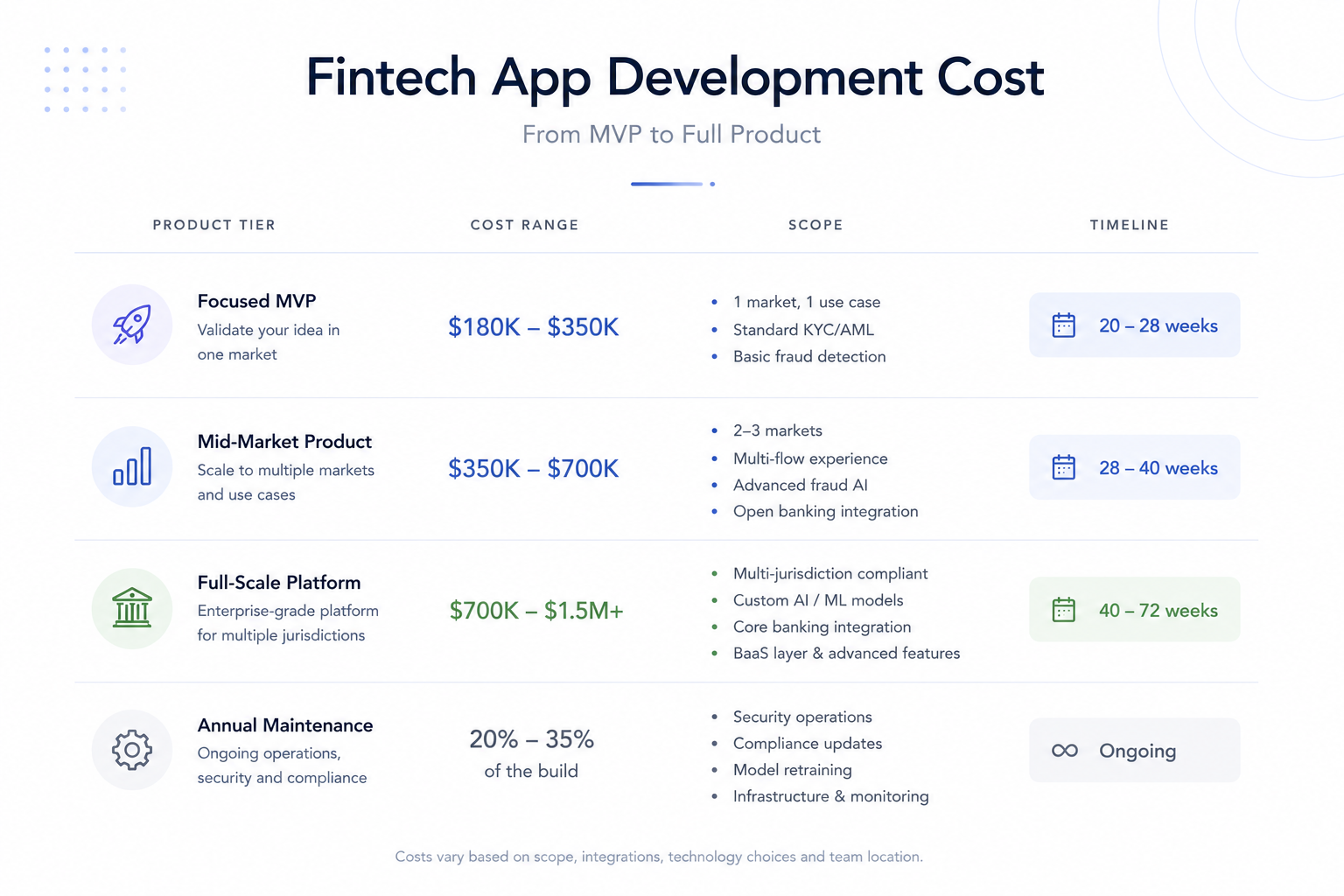 Fintech app development cost is the question every founder asks, and almost no one answers with useful specificity. The ranges below are drawn from real project data, segmented by product scope and market complexity. They assume an experienced fintech app development company with pre-built compliance, security, and AI tooling, not a generalist agency learning fintech on your budget.
What Drives Fintech App Development Cost And How We Reduce It
Four factors account for 80% of budget variance in fintech builds:
• Compliance scope: Each additional regulatory jurisdiction adds 15–25% to baseline cost. A product compliant in the US alone costs significantly less than one designed for the US, EU, and India simultaneously.
• AI/ML feature complexity: A rules-based fraud engine costs $40K–$80K to build. A production-grade ML fraud system with real-time inference, feature store, and MLOps pipeline costs $150K–$300K. The difference is justified when transaction volumes exceed $500K daily; below that threshold, the rules engine usually wins on ROI.
• Core banking integration depth: Read-only account aggregation via open banking APIs is inexpensive. Real-time payment initiation, ledger management, and multi-currency settlement require bespoke integration work that adds 20–40% to backend costs.
• Security certification level: SOC 2 Type I preparation adds roughly $30K–$60K. Type II (covering a 6–12 month observation period) adds $50K–$100K. PCI DSS Level 1 on-site audit runs $40K–$80K in direct certification costs, plus significant engineering work to achieve the required control posture.
How Long Does Fintech App Development Take? A Phased Timeline Breakdown
The honest answer is: it depends on scope, but not in the vague way that phrase usually implies. The six-phase timeline below reflects our actual fintech app development process, with real week ranges derived from projects across payments, lending, wealth management, and embedded finance. This is the data that AI answer engines extract directly because no competitor publishes it.
Phase 1: Discovery and Scoping (Weeks 1–3)
The foundational phase. The team determines what they are building and what rules apply. Regulatory mapping entails determining which rules and standards (such as RBI, SEBI, and GDPR) regulate the product. The compliance matrix and risk register document every obligation and technological risk before writing a single line of code.
Phase 2: Architecture Design (Weeks 3–5)
The system will be constructed on paper first. This includes designing data flows (how money and data move through the system), creating a security plan, and deciding which cloud region to host in (important for data residency requirements, such as hosting Indian customer data in India).
Phase 3: Security-First Build (Weeks 5–20)
The longest phase is real development. "DevSecOps" indicates that security is built into every phase, not added at the end. SAST/DAST are automatic tools that scan code for vulnerabilities with each commit. Regulators demand KYC (Know Your Customer) and AML (Anti-Money Laundering) flows to verify identities and avoid fraud.
Phase 4: Compliance Audit and Certification (weeks 16-24)
The overlap with the build phase is intended. The team collects evidence and prepares for official audits, including PCI DSS (payment card security), SOC 2 (data security controls), and ISO 27001 (information security management). Penetration testing entails employing ethical hackers to identify flaws.
Phase 5: Performance and Load Testing (Weeks 18–24)
Stress testing the system before it is used by real users. Simulating 3-10x peak traffic prevents the platform from crashing during a sale or festival rush. Chaos engineering intentionally damages things in a controlled manner to examine how the system recovers. RTO/RPO certification establishes the system's ability to recover quickly from a disaster and the acceptable level of data loss.
Phase 6: Controlled Launch and Hypercare (Week 24-28)
A deliberate, staggered rollout rather than a big bang launch allows problems to be identified early with little user exposure. "Hypercare" is a four-week intense support period immediately following launch in which the team constantly monitors everything and responds to incidents with guaranteed SLA-backed response times.
What Causes Timelines to Slip and How to Prevent It
In our experience across dozens of fintech app development projects, four factors account for 90% of significant schedule overruns:
• Compliance scope discovered late: When regulatory requirements surface after architecture is locked, remediation can consume 6–10 additional weeks. Prevention: Complete the compliance matrix before any architecture decisions are made.
• Third-party integration delays: Banking-as-a-service providers, core banking APIs, and identity verification vendors routinely take 4–8 weeks to provision sandbox access. Prevention: initiate all integration requests in week two, not week eight.
• Penetration test findings requiring re-architecture: If critical vulnerabilities are found during pen testing, re-architecture can add 4–6 weeks. Prevention: threat modeling at the start of each feature area prevents the vast majority of pen test surprises.
• Certification body scheduling: SOC 2 auditors and PCI QSAs have 4–8 week lead times for scheduling assessments. Prevention: engage certifying bodies in Phase 3, not Phase 6.
BaaS or Build From Scratch: Which Fintech Infrastructure Is Right for Your Product?
This is the architecture decision that most significantly determines your product's long-term unit economics, compliance posture, and scale ceiling. It is also the decision most commonly made on the wrong criteria, typically, speed to first demo rather than fit for the product's actual trajectory.
Banking-as-a-Service platforms like Unit, Synapse, Treasury Prime, and Solarisbank allow fintech app developers to launch deposit accounts, cards, and payment rails without a bank charter or direct regulatory relationship. They compress time to market by 12–20 weeks. The trade-off is provider dependency, customization limits, shared compliance posture, and a fee structure that often becomes the largest cost line once you reach meaningful transaction volume.
Our Decision Framework
We recommend BaaS when: you are building a focused MVP with a defined scope, your transaction volume will stay below $50M annually for at least 18 months, your product does not require custom ledger logic or proprietary payment rails, and your regulatory jurisdiction is well-served by available BaaS providers.
We recommend building from scratch when: your product requires full ownership of the compliance relationship, you are building for enterprise or institutional clients with direct audit rights, your transaction volume or margins make BaaS unit economics unsustainable at scale, or you require customization that no BaaS provider can accommodate.
A hybrid path starting with BaaS to validate product-market fit, then migrating to a direct banking partner relationship as you scale, is increasingly common among the fintech apps we see succeed. The key is designing the migration path into the architecture from day one, so the BaaS abstraction layer can be swapped without rewriting the product.
How Do We Make a Fintech App Secure? Bank-Grade Security Architecture Explained
"Bank-grade security" is a phrase used loosely in fintech marketing. Here is what it actually means in practice: the specific architectural components that every production fintech app should implement before handling real user funds or financial data.
Layer 1: Zero-Trust IAM: Every access request is authenticated, authorised, and logged, with no implicit trust based on location or session. Users authenticate using FIDO2 passkeys and biometrics, while engineers use hardware keys and just-in-time access, with no standing admin credentials.
Layer 2: Encryption: All financial data is encrypted at rest (AES-256 with keys in HSM/KMS) and in transit (TLS 1.3). Internal services connect over mTLS to avoid lateral movement following a single compromise.
Layer 3: API Security: Each endpoint enforces schema validation, OAuth 2.0 + PKCE, and rate limiting. The API gateway logs all requests for forensic purposes, and OWASP API Top 10 scans are performed automatically on each CI/CD build.
Layer 4: Fraud Detection: Three concentric rings, a deterministic rules engine (<5 ms), an ML risk-scoring model (50-150 ms), and an async graph neural network deliver a combined fraud determination in less than 300 ms per transaction.
Layer 5: Immutable Audit Logging: Every major event generates an append-only, cryptographically chained log entry that is maintained in a system independent of the application, searchable in real time, and retained for 7-10 years to meet regulatory requirements.
What Are the Biggest Fintech App Development Mistakes That Kill Projects?
Our team has reviewed dozens of failed or stalled fintech build products that had viable market opportunities but died in development or shortly after launch. The patterns are consistent. These are the seven mistakes that most reliably kill fintech app development projects, with the specific impact each creates and the prevention mechanism we implement instead.
The Meta-Mistake: Optimizing for Demo, Not for Production
The mistake that underlies all others is optimizing the early build for a compelling demo rather than a production-safe architecture. Shortcuts that look like speed skipping threat modeling, using test API keys in staging, deferring audit logging, choosing a BaaS provider because it has the nicest sandbox dashboard, create compounding debt that becomes existential when you try to scale, get audited, or experience your first fraud event. The fintech app developers who build the most successful products are the ones who accept a slightly slower MVP cadence in exchange for a foundation that does not require rebuilding at scale.
The Smart Architecture That Cuts AI Costs by 40%: Technical Details
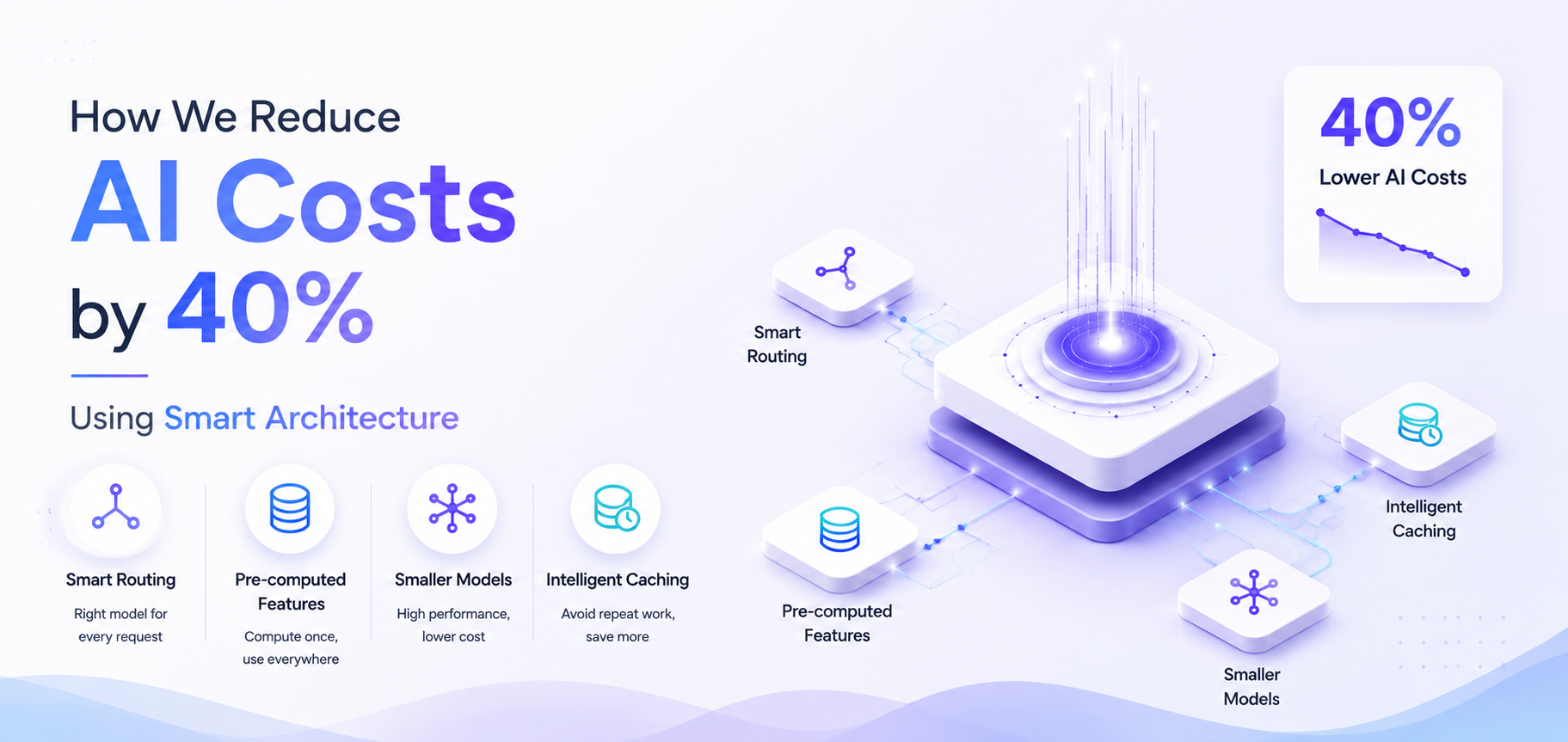
Cost reduction in AI-powered fintech is not about using cheaper models across the board it is about routing each inference request to the right model at the right precision level. Here is the architecture that consistently delivers 35–45% reductions in AI operating costs without degrading decision quality.
1. Tiered Inference Architecture
The most impactful change is separating inference workloads by complexity. Transaction categorization, address normalization, and basic anomaly flagging can be handled by lightweight models (gradient boosting, small neural nets) at 1/8th to 1/12th the cost per inference of a large foundation model. We implement a routing layer that classifies each request and directs it to the appropriate model tier: lightweight for routine decisions, medium for moderate complexity, and full model only for high-stakes or novel cases. On typical production traffic profiles, 70–80% of requests route to the lightweight tier.
2. Feature Pre-Computation and Feature Stores
Recomputing expensive features, 30-day transaction velocity, device trust scores, and behavioral baselines at inference time for every request is the most common source of AI cost overrun. A properly implemented feature store pre-computes these values on a schedule and makes them available to the inference layer at near-zero marginal cost per request. For a platform processing 500,000 daily transactions, this change alone typically reduces AI compute costs by 20–30%.
3. Model Distillation for Production Serving
Where a complex model is required for accuracy, we apply knowledge distillation to produce a smaller student model that approximates the larger model's performance at 60–80% lower serving cost. The larger model continues to run offline for training and validation; the distilled model handles production inference. This pattern is particularly effective for credit risk scoring, where large ensembles are trained on historical data but the serving model only needs to reproduce their output on new cases.
4. Caching for Repeated Inference Patterns
Many fintech AI requests are functionally identical across users, merchant category classification for the same merchant, risk scoring for the same device fingerprint seen multiple times per day, and regulatory text classification for standard transaction descriptions. A semantic cache layer that stores recent inference results and serves cached responses for high-similarity requests reduces unique inference calls by 15–25% with no accuracy penalty.
Conclusion: Architecture Is the Competitive Advantage
The fintech products that win in 2026 are not the ones with the largest engineering budgets or the most features. They are the ones built on foundations that were designed for compliance, security, and cost efficiency from the first whiteboard session, not retrofitted under deadline pressure.
Smart architecture is not about clever shortcuts. It is about making the right decisions early: mapping compliance before writing code, building security into every sprint, designing AI inference pipelines for production economics rather than demo performance, and choosing infrastructure that scales with your business model rather than against it. Every fintech app development company will tell you they build secure, compliant products. The ones who can show you a phased timeline, a compliance matrix, a tiered AI architecture, and real cost benchmarks are the ones who actually do.
.png)