
Not long ago, automation meant creating a script that performed a single task, such as sending an email, updating a spreadsheet, or triggering an alert. It was useful, definitely. But it was brittle. One unexpected input, and everything came apart. You still require a human to make genuine decisions. We've now crossed a different kind of threshold.
It's about agentic AI in business systems that not only perform predetermined tasks but also reason through challenges, respond to new knowledge, and follow chains of action to achieve goals. Businesses that recognise this transition early on benefit from more than just time savings. They're profoundly changing how work is done.
This blog is not a promotional item. It's a grounded look at what agentic AI is, why it's gaining unstoppable speed in business, what real-world applications look like, and most importantly, where the hazards lie if you rush in without a plan.
What Makes AI “Agentic”?
You've definitely utilised artificial intelligence to answer queries. Maybe you've utilised AI to generate content or code. That is impressive, but it is still basically reactive: you prompt, it responds, and the discussion ends.
Agentic AI differs in one significant way: it can act. It does not simply generate an output and then stop; instead, it analyses if it met a goal and decides what to do next. It works with tools. It searches the web, reads files, writes code, accesses APIs, and completes several phases without your intervention.
Consider the difference between a calculator and an accountant. An accountant understands your goals, asks clarifying questions, gathers information from many sources, and makes a suggestion – which he or she then assists you in implementing.
That is the mental model change underlying agentic AI workflows. AI is more than just a tool you utilise. It's a collaborator with some autonomy. What makes this possible now, in 2026, is the convergence of numerous factors: huge language models with robust reasoning, dependable tool-use capabilities, improved memory architectures (both short and long term), and cheaper, faster inference. Two years ago, the components were theoretically fascinating, but today they can be deployed in practice.
The Growing Business Speed Behind Agentic AI
Here's something worth sitting with: the businesses moving fastest on agentic AI aren't always the biggest ones. Some of the most compelling implementations are coming from mid-sized companies and startups that looked at their operational costs and thought, "We can't grow our headcount to solve this problem; we need a different kind of solution." And what they found was that agentic AI let them scale operations that previously required teams. Not replace their teams, but let small teams operate at a scale that simply wasn't possible before.
The business Speed is real, and it's accelerating. Here's why:
Cost pressure is intensifying. Inflation, hiring challenges, and competitive margins are forcing companies to find ways to do more with the resources they have.
AI quality has crossed a threshold. Models today can handle nuanced, multi-step tasks with enough reliability to be trusted in production environments, not just in demos.
Infrastructure has matured. Tooling around deployment, monitoring, and safety for agentic systems has grown substantially. Running an AI agent in production is still complex, but it's no longer an experimental frontier.
Early movers are seeing real ROI. When competitors start releasing outcomes, whether it's faster research cycles, lower operational expenses, or more customer happiness, others take notice.
The question is not whether agentic AI will transform the way businesses operate. That is already happening. The question is whether your organisation will be ahead of the curve or catching up.
Top AI Agent Applications in Business Today
Let's get specific. Where are AI agentic workflows actually being deployed in 2026, and what do they look like in practice?
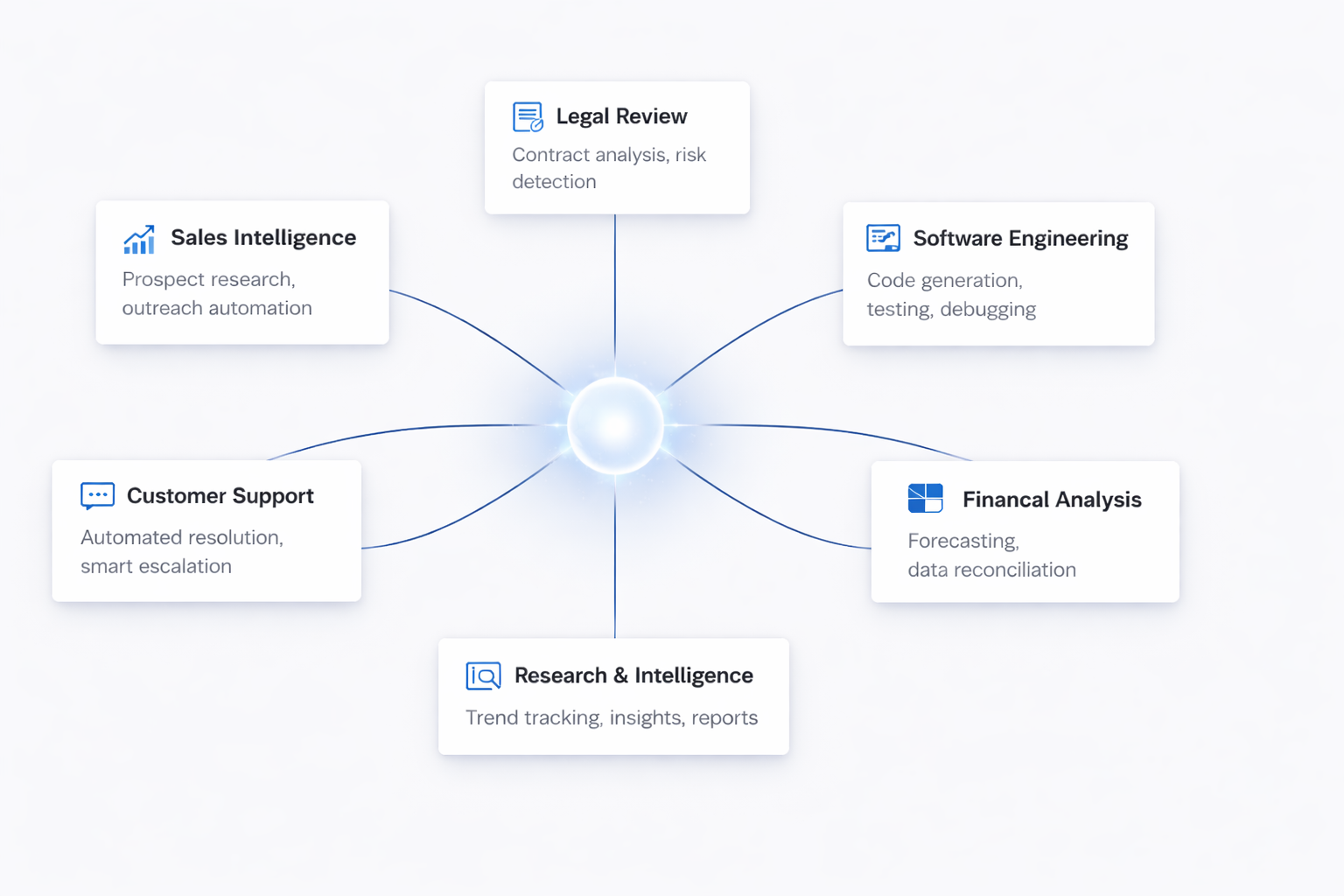
1. Sales & Revenue Intelligence
Sales teams historically spent enormous amounts of time on research, understanding prospects, personalizing outreach, and following up at the right moment. Agentic systems can now handle the entire pre-sales intelligence cycle.
An AI agent can pull data on a target account from multiple sources, synthesize it into a brief, draft personalized email sequences, monitor for trigger events (like a funding announcement or leadership change), and automatically surface the right account to a rep at the right moment. The rep's job shifts from research to relationship, which is what great salespeople actually want to be doing.
2. Legal & Compliance Review
Reviewing contracts, flagging risks, and cross-referencing regulatory requirements used to require expensive attorney time or highly specialized staff. Agentic systems can now read through hundreds of documents, identify clauses of concern, compare them against standard templates, and produce summary reports with flagged issues.
Legal teams still make the final call. But the volume of work they can handle and the speed at which they can respond have changed dramatically.
3. Software Engineering & QA
AI software development agents don't just autocomplete code anymore; they can interpret a feature request, write code, run tests, identify failures, debug, and submit a pull request. Engineering leads report that junior-level implementation tasks are increasingly being handled by agents, freeing engineers to focus on architecture, system design, and complex problem-solving.
The shift isn't that developers are going away. It's that the ratio of impact per developer is changing.
4. Customer Support Operations
Traditional chatbots frustrated customers because they couldn't actually solve problems; they could only route them. Agentic customer support systems can actually resolve issues: look up order status, process refunds, update account information, and escalate intelligently when warranted by the situation.
The customer experience is categorically different when the AI can actually do something rather than just answer questions.
5. Research & Competitive Intelligence
Following up with industry innovations, tracking competitors, and synthesising market trends were once the responsibility of specialist analyst teams. Agentic research tools may now consistently track sources, summarise developments, detect patterns, and provide customised reports. For strategy and product teams, having a constantly updated perspective of the competitive landscape, rather than waiting for a quarterly report, alters how choices are made.
6. Financial Analysis & Forecasting
Finance teams are utilising agents to automate the arduous portions of financial research, such as gathering data from numerous systems, reconciling statistics, creating scenario models, and preparing draft reports. Instead of wrangling data, analysts may focus on interpretation and strategy.
Industry Examples & Case Studies
Theory is useful. Examples are better. Here's how agentic AI is playing out across sectors:
Healthcare: A hospital network built an AI agent to handle prior authorisation requests, which are one of the most time-consuming administrative tasks in healthcare. The agent collects patient information, cross-checks insurance criteria, and submits.
E-commerce: A mid-sized store developed an agentic system to manage returns and exchanges from beginning to end. Customers take part organically, while the agent validates orders, determines policy approval, begins the return in the warehouse system, and processes refunds. Humans are now handling exceptions rather than regular cases.
Professional Services: A consulting firm employs an agent to handle the first phase of new client engagements, which includes gathering industry data, assessing the client's public footprint, identifying prospective areas of focus, and developing the initial diagnostic. What once took a junior consultant three days now takes only a few hours.
Manufacturing: Agents were deployed on the factory floor to monitor equipment sensor data, discover anomalous patterns, cross-reference maintenance logs, and automatically schedule preventative maintenance prior to breakdowns. Downtime has decreased considerably.
The trend is consistent across all of these examples: agentic AI handles the volume, research, and routine complexity, while humans make the critical decisions that demand knowledge.
Benefits of Adopting Agentic AI in Business
The case for agentic AI in business isn't just theoretical. Organizations that have moved thoughtfully on this are reporting concrete advantages:
Speed at scale. Tasks that required hours or days can be completed in minutes. Across an organization, this compounds fast.
Consistent execution. Agents don't have good days and bad days. They follow processes consistently, which matters enormously for compliance-heavy or quality-sensitive work.
Elastic capacity. During peak periods, product launches, open enrollment, and quarter-end, agents can absorb volume spikes that would otherwise require costly temporary staffing.
Reduced cognitive load on humans. When agents handle the routine complexity, human workers can focus on higher-value work. Burnout from repetitive tasks decreases. Engagement tends to improve.
Institutional knowledge preservation. Well-designed agentic systems encode organizational knowledge processes, preferences, and standards in ways that persist beyond individual employees.
Faster iteration. In product development, strategy, and research contexts, the ability to move faster through cycles of hypothesis-testing and analysis creates real competitive advantage.
None of these benefits happens automatically. They require thoughtful design, proper integration, and ongoing management. But for organizations that do the work, the returns are substantial.
Challenges & Risks to Consider
This is the part that doesn't get enough attention in the enthusiasm around AI capabilities. Agentic AI introduces real risks that organizations need to understand before deploying.
Reliability and error propagation. Agents that take multi-step actions can compound mistakes. If step 3 is based on a flawed output from step 1, by the time the error is visible, it may have cascaded into real consequences. Robust human checkpoints and fallback mechanisms aren't optional — they're foundational.
Security vulnerabilities. Agents that interact with external systems, read documents, or browse the web can be manipulated through prompt injection attacks.
Accountability gaps. When an agent makes a decision that causes a problem, who's responsible? The organization is deploying it full stop. But internal governance structures need to reflect this. "The AI did it" is not an acceptable answer to regulators, customers, or partners.
Over-automation risk. The temptation to automate everything can erode the human judgment that's actually essential in edge cases. The best agentic deployments are designed with clear escalation paths, so the system knows when to bring a human in.
Organizational resistance. People worry about their jobs. That's legitimate and deserves honest engagement, not dismissal. Organizations that communicate clearly about how agentic AI changes roles rather than just deploying it and hoping for the best see much smoother adoption.
The organizations that navigate this well share something in common: they treat agentic AI deployment as a change management challenge, not just a technology challenge.
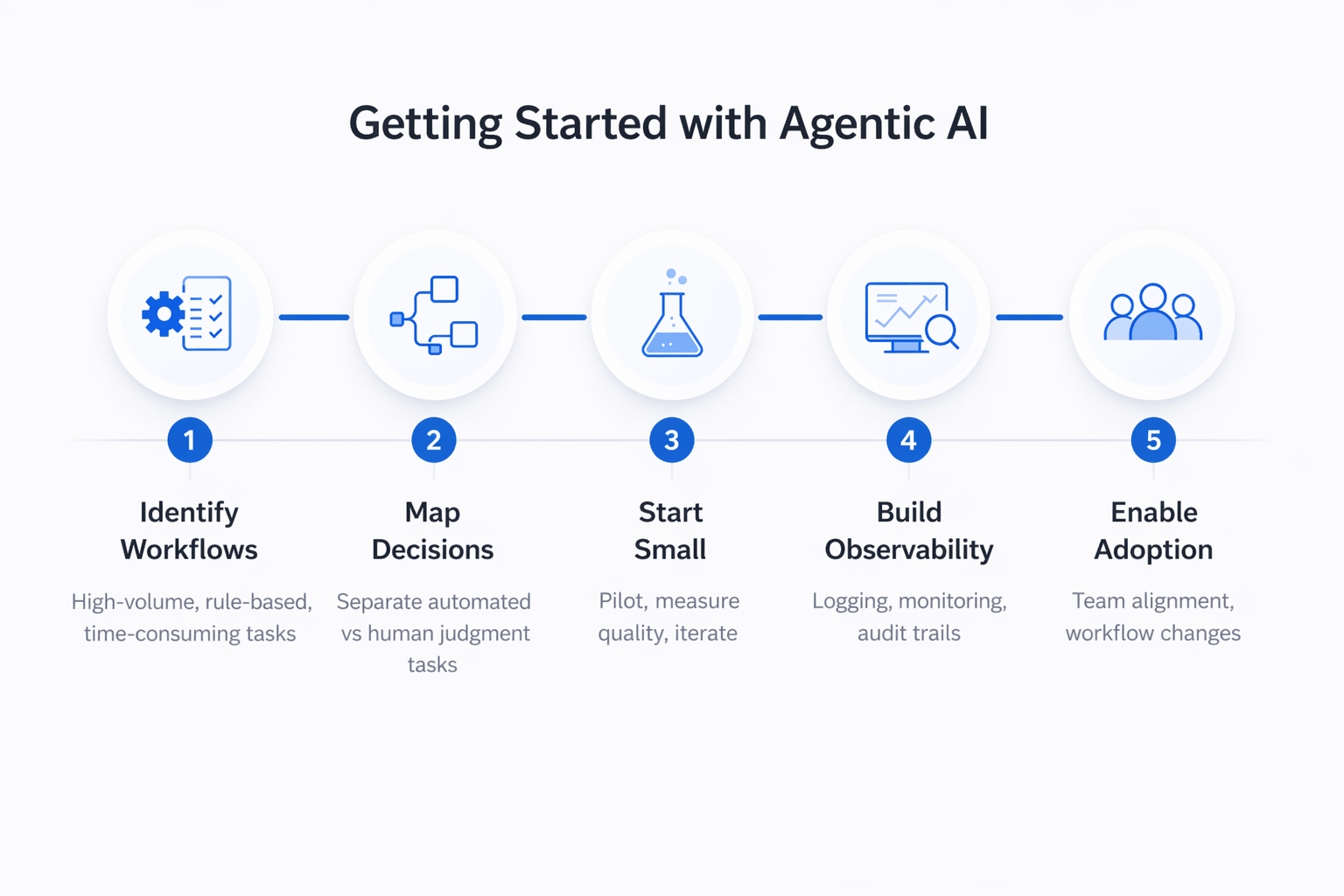
How to Get Started with Agentic AI
The key idea for developing agentic AI applications using an issue-first approach is right there in the phrase: problem first.
Don't start with the technology and look for a place to use it. Begin by identifying a real, particular operational pain point that your team faces regularly, with measurable cost or friction, and then consider whether an agentic system could help.
Here's a practical starting framework:
Step 1: Identify your highest-friction workflows. Look for processes that are high-volume, rule-governed, and time-consuming. These are typically the best candidates for agentic automation.
Step 2: Map the decision points. In any workflow, some decisions require human judgment, and some don't. Be explicit about which is which. Build your agentic system to handle the latter confidently, and escalate the former intelligently.
Step 3: Start small and measure. Pilot on a narrow scope. Measure quality of outputs, time savings, and error rates. Get feedback from the humans working alongside the system. Iterate before expanding.
Step 4: Build for observability. You need to be able to see what your agent is doing and why. Logging, monitoring, and audit trails aren't just nice to have; they're essential for trust and governance.
Step 5: Invest in change management. Brief your team. Explain what the agent will handle and what it won't. Define new workflows around the agent. Celebrate early wins.
The teams that get the most out of agentic AI early on are usually not the ones who move fastest; they're the ones who move most deliberately.
 Agentic AI vs traditional AI
Building on Autonomous AI Systems: A Note for Developers
For those involved in AI software development and building these systems rather than just using them, a few principles that separate good agentic architectures from brittle ones:
Autonomy should be calibrated, not maximized. Autonomous AI systems that ask for confirmation at appropriate junctures perform better in real-world deployments than those optimized to minimize human interaction. Trust is earned through reliability, not assumed.
Tool use should be minimal and intentional. Give agents only the tools they actually need for the task. A system with access to everything is harder to secure, harder to debug, and harder to trust.
Memory architecture matters more than most teams initially realize. How an agent retains context within a session, across sessions, and at the organizational level fundamentally shapes how useful it is over time. Invest in getting this right.
Failure modes should be designed explicitly. What does the agent do when it's uncertain? When a tool call fails? When it detects, it may be making an error. Systems without thoughtful failure handling will fail in unpredictable ways at the worst moments.
Future Trends & What to Expect in 2026 and Beyond
The evolution of agentic AI workflows isn't slowing down. Here's what the trajectory looks like from where we stand:
Multi-agent collaboration. We're moving toward systems where multiple specialized agents work together, a research agent, a writing agent, and a fact-checking agent coordinated toward a shared goal. The orchestration of agent networks is an emerging discipline.
Deeper enterprise integration. Agents will increasingly be embedded into the tools people already use, such as CRMs, ERPs, and development environments, rather than requiring separate interfaces.
Better grounding in organizational knowledge. Agents that have access to your company's actual documents, policies, historical decisions, and communications will be dramatically more useful than general-purpose ones. The companies building rich internal knowledge bases now will have a significant advantage.
Evolving regulatory landscape. Governments are developing frameworks for AI in high-stakes domains. Healthcare, finance, legal, if you're building autonomous AI systems in these areas, staying ahead of compliance requirements is essential, not optional.
Commoditization of basic capabilities. Simple agentic workflows will become cheap and easy to build. The competitive differentiation will come from the quality of your training data, the design of your workflows, and the depth of your organizational integration.
The businesses that thrive will be those that view agentic AI not as a one-time implementation project, but as a continuous capability to build and refine.
Final Thoughts
There's a version of this story that gets told as pure techno-optimism: AI is going to do everything, productivity is going to explode, friction is going to disappear. That version is both overstated and unhelpful.
The real story of agentic AI in business in 2026 is more interesting and more human. It's about organizations realizing they can give their people better work to do. It's about teams that were drowning in repetitive volume getting their heads back above water. It's about the person who used to spend three days on a research project and now spends three hours, and uses the other time actually to think.
None of that happens without real work: careful selection of use cases, thoughtful system design, honest risk assessment, and genuine investment in the humans working alongside these systems.
But for the organizations willing to do that work, autonomous AI systems aren't just a competitive advantage. They're a qualitatively different way of operating, one that gets more powerful every quarter as the underlying technology improves and your team gets better at working with it.
The question isn't whether this shift is coming. It's whether you'll be the one leading it in your space, or trying to catch up to someone who did.
.png)